
Views: 222 Author: Long Win Display Publish Time: 2026-05-27 Origin: Site


Paper gift boxes are a strategic piece of retail and e‑commerce branding, and North America remains one of the most important regions for premium gift packaging globally. For procurement managers, choosing the right long‑term paper gift box partner in or serving the American market is less about price lists and more about certifications, structural engineering capabilities, and supply chain reliability. [myboxprinter]
When screening paper gift box manufacturers for long‑term cooperation, we use a combination of factory, process, and market indicators rather than marketing claims. The core criteria include: [precedenceresearch]
- Factory certifications and compliance: ISO 9001 for quality systems, ISO 14001 for environmental management, and FSC for responsible paper sourcing, verified via accredited certification bodies and official databases such as IAF CertSearch rather than just relying on PDFs sent by sales reps. [linkedin]
- R&D and structural design capability: In‑house packaging engineers who can design complex structures (magnetic closure, collapsible boxes, drawer boxes, shoulder‑neck boxes) and validate them via prototypes and transport testing. [lionpaper-istyle]
- QC process and traceability: Documented quality manuals, incoming material inspection, in‑process checks, final AQL inspection, and the ability to trace each batch by production date, machine, and operator. [myboxprinter]
- Capacity and lead‑time stability: Clear daily or monthly capacity (e.g., pieces per day), realistic peak‑season planning, and evidence of on‑time delivery performance for major retail programs. [myboxprinter]
- Export experience and communication: Experience supplying to US and European retailers, familiarity with HTS codes such as 4819.20.00 for folding cartons and boxes, and the ability to work under Incoterms and retailer compliance manuals. [customsmobile]
This article applies these criteria to profile leading paper gift box manufacturers and suppliers that serve the American market, including domestic US producers and export‑oriented partners such as Long Win Display in China that already support major North American brands. [precedenceresearch]
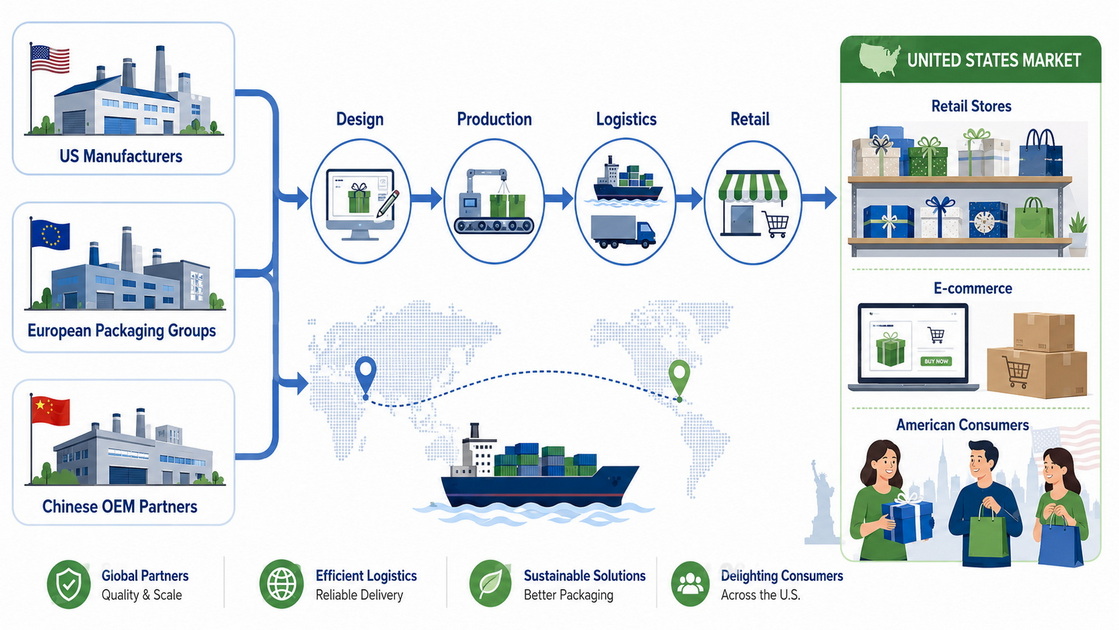
North America accounts for roughly 37% of global gift packaging revenue, with the US gift packaging market alone estimated at about 8 billion USD in 2025 and projected to exceed 13 billion USD by 2035. Within this segment, paper and paperboard hold a significant share—around 44% of global gift packaging materials—driven by retailer policies and consumer pressure for recyclable, plastic‑free packaging. [myboxprinter]
For brands selling into the US and Canada, there are two main sourcing models: domestic production close to distribution centers, or offshore production (often China or other Asia‑Pacific hubs) combined with ocean freight and regional warehousing. US‑based producers offer faster replenishment and easier compliance alignment, while specialized Chinese manufacturers can deliver broader customization, strong cost‑to‑value ratios, and high volumes for complex campaigns targeting the American market. [linkedin]
Below are representative manufacturers and suppliers that meet the above criteria. Where official data is limited, procurement managers should treat the profiles as starting points for deeper due diligence.
Long Win Display Shenzhen Limited is a China‑based POP display and packaging manufacturer that has been in the display and packaging field for more than 20 years, with particular expertise in cardboard display stands, display boxes, gift boxes, and package boxes. The company is headquartered in Shenzhen, with its production facilities relocated to Yiwu, Zhejiang after 2020 to leverage that region's trading ecosystem and cost advantages.
From an American buyer's perspective, Long Win Display is especially relevant as a high‑value OEM/ODM partner for paper gift boxes that will ultimately be sold in US and other international markets. The factory operates with full sets of production equipment covering design, prototyping, printing, and production, and it implements a defined quality control procedure across these stages.
Key characteristics that matter to procurement managers include:
- Experience and R&D: The leadership team has been in display and packaging design since at least 2006, and the company has supported big retail programs for brands entering chains like Walmart, Costco, Coles, and 7‑Eleven, which indicates familiarity with international retailer compliance and logistics constraints.
- Capacity and footprint: Long Win operates an 8,000‑square‑foot factory with around 60 employees and about 20 main production facilities, reporting a daily capacity of roughly 10,000 pieces across its product range.
- OEM/ODM flexibility: The company emphasizes customization, cost‑effective structural design (reducing material waste and packaging volume), and the ability to preload displays and packaging, which is critical for in‑store execution programs.
For small and mid‑size brands in America, Long Win is particularly attractive when you need:
- Custom paper gift boxes matched with POP displays for retail campaigns.
- Support for iterative design and structural optimization to meet both branding and logistics cost targets.
- A supplier used to multi‑market exports (Asia, North America, Oceania, Europe) rather than single‑market production.
While Long Win is physically located in China, many US‑focused programs rely on precisely this type of export‑oriented factory to combine advanced customization with competitive cost per unit.

Major consumer gift packaging brands and converters such as Hallmark and IG Design Group appear among the key companies in recent global gift packaging market reports. These groups combine brand ownership with substantial design and converting capacity for items like gift boxes, wrapping paper, and coordinated gift packaging sets. [myboxprinter]
They are strong partners when you need trend‑driven seasonal collections, licensed designs, or coordinated programs for large retail networks, and they operate under robust quality and safety frameworks aligned with North American regulations. However, their business model may favor large seasonal commitments, which can be less flexible for emerging or niche brands compared with dedicated OEM factories. [myboxprinter]
Alongside the large players, the US has a layer of mid‑sized converters that focus on custom rigid and folding gift boxes, particularly for cosmetics, confectionery, and premium retail. These companies typically offer: [flickpack]
- Shorter lead times for North American customers, often with digital or short‑run offset capacity for frequent design changes.
- Strong service for structural sampling, line trials, and small‑batch launches, making them suitable for new product development phases. [myboxprinter]
Their main constraints are generally higher unit costs versus Asia‑based suppliers for high‑volume orders and sometimes limited access to certain specialty papers that are more common in Asia's packaging clusters. [flickpack]
International Paper is widely recognized as one of the largest paper‑based packaging manufacturers in the US, with extensive capabilities in corrugated and paperboard packaging that many brands leverage for secondary and gift‑related packaging. While its primary focus is on corrugated and industrial applications, its scale, domestic footprint, and experience with major retailers make it a strategic option for brands that want to integrate gift box programs into broader packaging contracts. [flickpack]
Strengths include vertically integrated paperboard supply, strong environmental and sustainability reporting, and the ability to support enterprise‑level contracts across multiple packaging categories. For procurement managers, International Paper is best suited when paper gift boxes are part of a multi‑category, long‑term packaging strategy rather than standalone small runs. [flickpack]
Several European and global packaging groups highlighted in market reports—such as Smurfit Kappa and Mondi—also serve US and North American customers with premium and sustainable gift packaging solutions. These companies often bring advanced sustainability programs, recycled content strategies, and networked design centers that can be leveraged by US and global brands that want unified packaging standards across regions. [myboxprinter]
For US procurement managers, these suppliers can be valuable when you need:
- Harmonized packaging specs and sustainability metrics across the US, EU, and other markets.
- Advanced paper engineering for lightweight yet rigid structures, especially where logistics emissions and shelf impact are KPIs. [myboxprinter]
Choosing the right supplier for paper gift boxes requires a clear understanding of materials, processes, and certifications that impact both performance and compliance.
Key technical aspects include:
- Material grades: Common substrates include coated and uncoated paperboard, greyboard for rigid boxes, and corrugated for mailer‑type gift boxes, with paper and paperboard accounting for around 44% of global gift packaging materials by revenue. Buyers should specify GSM, caliper, and recycled content to avoid hidden downgrades. [myboxprinter]
- Finishing and convertibility: Premium gift boxes often rely on combinations of offset or digital printing, lamination, hot foil stamping, embossing/debossing, and spot UV, which require precise process control to avoid registration issues or cracking at folds. [lionpaper-istyle]
- Environmental certifications: While the user question mentions CE/RoHS, these are typically more relevant to electronics; for paper gift boxes, buyers should look more closely at FSC or PEFC for fiber sourcing, ISO 14001 for environmental management, and local packaging waste or recycling regulations in the US and target markets. [lionpaper-istyle]
Sustainability expectations are increasing: paper and paperboard already represent a dominant share of gift packaging, and regulatory and consumer pressure continues to push brands toward recyclable, plastic‑free designs. [lionpaper-istyle]
Real‑world procurement experience shows that the main risks rarely appear in glossy catalogs.
Common pain points when sourcing paper gift boxes include:
- Material downgrading: Substituting lower‑GSM or lower‑grade board than quoted, which may only be obvious after transport damage or side‑by‑side comparison with reference samples. This often happens when buyers focus only on unit price without locking down specifications and tolerances.
- Over‑packaging vs. compliance: For markets like China, there are specific standards such as GB 23350—2021 that restrict excessive packaging for certain categories; similar sustainability trends influence US retail, so "luxurious" boxes must be balanced with material reduction and recyclability to avoid complaints or regulatory issues. [lionpaper-istyle]
- Certification gaps: Vendors may showcase ISO or FSC logos without having current, accredited certificates; if the certificates are not issued by an accredited certification body, they may not satisfy retailer audits. [linkedin]
A less discussed "insider" risk is uncontrolled specification drift: over multiple reorders, some suppliers gradually alter board sources, coating weights, or even internal dimensions without explicit change notices, especially when buyers do not track retain samples and inspection records. The result is that year‑three boxes may look similar but behave differently in automated packing lines or fail stacking and compression tests. This is why serious buyers keep golden samples, link them to PO numbers, and require formal approval for any material or process change.

Within the industry, procurement teams that consistently avoid failures follow a few practices that are seldom outlined on public websites:
- Track specifications at project level, not just at supplier level: Maintain a specification sheet per SKU that includes material grade, GSM, caliper, adhesive type, and finishing processes, and require the supplier's QC department to sign against it for each production batch.
- Ask to meet the QC manager, not just sales: In factory audits (onsite or remote), seasoned buyers always speak directly with the QC or production manager to understand real‑world issues and reject rates rather than relying on sales presentations. [linkedin]
- Review non‑conformance records: Before awarding larger volumes, ask for anonymized examples of recent quality incidents and how they were handled; serious manufacturers can show you CAPAs (Corrective and Preventive Actions), not just "we have no problems."
Suppliers like Long Win Display that can walk you through their end‑to‑end process—design, prototyping, printing, production, and delivery—give you better visibility to enforce this kind of disciplined spec management.
- Global gift packaging market: about 28.82 billion USD in 2025, projected to reach roughly 45.94 billion USD by 2035, a CAGR of about 4.77% from 2026 to 2035. [myboxprinter]
- Material mix: paper and paperboard hold a significant share (~44%) of the global gift packaging market, underlining the importance of paper gift boxes in sustainability strategies. [myboxprinter]
- Regional share: North America holds around 37% of global gift packaging revenue, with the US market projected to grow from 8 billion USD in 2025 to over 13 billion USD by 2035. [myboxprinter]
- Certification verification: ISO itself does not issue certificates; buyers must verify certificates through accredited certification bodies and can use resources like the International Accreditation Forum's CertSearch. [precedenceresearch]
These data points help justify internal investment cases for better‑engineered paper gift box programs serving the US market.
The table below summarizes typical profiles you will encounter when sourcing paper gift boxes for US and North American distribution, including how a flexible OEM like Long Win Display fits into the picture.
| Supplier type | Typical location | Capacity / scale | Typical MOQ | Key certifications focus | OEM/ODM strengths | Best use case for US buyers |
|---|---|---|---|---|---|---|
| Long Win Display (OEM/ODM) | China (Shenzhen HQ, Yiwu factory) | Medium–high; approx. 10,000 pcs daily overall capacity with 8,000 sq ft plant | Flexible; can support small–medium brands and pilot runs | Focus on QC procedures and cost‑effective design; can align with customer‑requested systems (ISO/FSC via cooperated partners) | Deep OEM/ODM customization, integration with POP displays, structural cost optimization, multilingual communication | US and global brands seeking high customization and cost‑effective paper gift boxes and display‑plus‑packaging programs for retail and e‑commerce. |
| Large integrated paper group (e.g., International Paper) | US‑based with global operations | Very high; multiple mills and converting plants supporting millions of units | Often medium–high; favors larger programs | Strong focus on quality and sustainability systems; often ISO and chain‑of‑custody schemes | Strong structural and material engineering, but often within standard commercial ranges | Enterprise buyers bundling gift boxes into broader corrugated and paperboard packaging contracts. (flickpack) |
| Branded gift packaging groups (e.g., Hallmark, IG Design) | US, UK, EU with global distribution | High; strong seasonal and retail capacity | Medium–high; seasonal commitments | Compliance with North American safety and retailer standards; structured quality systems | Design‑driven, licensed artwork, coordinated seasonal sets | Retailers and large brands needing full seasonal programs rather than purely OEM boxes. (myboxprinter) |
| Mid‑sized US custom box converter | US regional | Medium; suitable for tens to hundreds of thousands of units | Low–medium; more flexible for pilots | Varies; often align with customer requirements and retailer audits | Fast sampling, local service, short‑run and quick‑turn customization | Brands prioritizing speed and local collaboration over lowest landed cost. (myboxprinter) |
| Global packaging groups serving US (e.g., Smurfit Kappa, Mondi) | Europe and other regions with US presence | High; multi‑country plant networks | Medium–high; global program focus | Advanced sustainability frameworks, recycled content strategies | Cross‑regional design, standardized specs across markets | Brands needing harmonized packaging standards and sustainability metrics globally. (myboxprinter) |
- Check the certification body, not just the certificate: ISO clarifies that certification is performed by external bodies; you should verify that the body is accredited, for example through the International Accreditation Forum's CertSearch or national accreditation bodies. [precedenceresearch]
- Request full certificate and scope: Ensure the scope of ISO 9001 or 14001 covers "printing and converting of paper packaging" or equivalent, and confirm the expiry date and surveillance audit status. [linkedin]
- Align sustainability claims with documentation: For FSC or similar schemes, ask for chain‑of‑custody codes and verify them through the issuing organization's public databases. [myboxprinter]
- Start with structure, then artwork: As many industry specialists recommend, you should first confirm the structural design (type of box, insert configuration, closure, and material grade) before finalizing print and finishing. [lionpaper-istyle]
- Pilot for logistics: Use samples to test how boxes perform in real packing lines, shipping cartons, and last‑mile conditions; small changes in board grade can significantly affect performance in the US parcel network. [lionpaper-istyle]
- Fix golden samples: Once approved, retain golden samples at both your premises and the factory, and tie all POs to these samples to limit specification drift over time.
- Clarify realistic lead times: For export suppliers, factor in production time plus ocean transit and customs clearance into US ports; this can easily extend total lead time to 60–90 days depending on the port and season. [lionpaper-istyle]
- Match MOQ to lifecycle: Avoid over‑ordering to chase lower unit prices if your design changes frequently; OEMs like Long Win Display can often offer more flexible MOQs for smaller brands, especially in combination with displays.
- Ask for peak‑season plans: Confirm how the factory prioritizes orders during Q4 or major holiday seasons when capacity and materials may tighten.
- Tariff classification: Paper gift boxes for the US often fall under HTSUS code 4819.20.00 for folding cartons, boxes, and cases of non‑corrugated paper or paperboard, which currently carry zero duty, though buyers should confirm up‑to‑date rates. [customsmobile]
- Retailer requirements: Large US retailers often have their own packaging guidelines for dimensions, barcoding, carton strength, and palletization; you should share these early so factories can design gift boxes that comply without later rework. [lionpaper-istyle]
- Sustainability disclosures: Prepare to report recycled content, recyclability, and packaging weight for sustainability reporting, especially when selling into US states or retailers with specific environmental reporting demands. [myboxprinter]
America's gift packaging demand is growing steadily, with paper gift boxes at the center of both sustainability and branding strategies for retailers and DTC brands. The most successful procurement teams combine domestic and export suppliers—integrated US packaging groups, regional converters, and flexible OEM partners like Long Win Display—to balance speed, customization depth, and total landed cost for the US market. [lionpaper-istyle]
1. How can I verify whether a supplier's ISO 9001 certificate is still valid and properly accredited?
Ask for a full copy of the certificate, identify the certification body, and check whether that body is accredited via national accreditation bodies or IAF CertSearch; ISO itself does not issue certificates. If the certification body is not accredited, investigate why and assess whether your customers or retailers will accept that certificate. [precedenceresearch]
2. What is a reasonable tolerance for material downgrading on paper gift boxes?
In professional procurement, there should be no unapproved downgrading; set explicit tolerances on GSM and caliper (for example ±5%) in your specifications, and include these in inspection checklists and golden sample comparisons. Any change beyond tolerance should trigger a formal change control process and your written approval. [lionpaper-istyle]
3. How do I align US sustainability expectations with offshore production?
Start by standardizing material choices (e.g., FSC‑certified paperboard with clear recycled content levels) and request regular documentation from offshore suppliers; link this to corporate sustainability metrics and ensure packaging remains recyclable under US waste systems. Factories that already serve eco‑oriented brands can usually provide tested material combinations. [lionpaper-istyle]
4. Can one supplier handle both POP displays and premium gift boxes for one US retail program?
Yes; suppliers like Long Win Display specialize in both cardboard displays and gift boxes, with the ability to preload displays and optimize structural design for both cost and shelf impact. For US retailers, this integration can reduce coordination complexity and improve program‑level consistency.
5. What is the best way to pilot a new paper gift box supplier without risking a major program?
Experienced buyers typically start with a limited‑scope project: one or two SKUs, a controlled rollout, and detailed quality and logistics monitoring; they review non‑conformance records and CAPAs and only then scale to national distribution. Structuring the contract with clear performance milestones and review points further reduces risk. [lionpaper-istyle]
1. Precedence Research. (2025). "Gift Packaging Market Size to Surpass USD 45.94 Bn By 2035".
https://www.precedenceresearch.com/gift-packaging-market
2. ISO. (2023). "Certification – How to check if an ISO certificate is valid".
https://www.iso.org/certification.html
3. U.S. Customs and Border Protection. (2009). "Customs Ruling NY N082715 – The tariff classification of gift boxes under heading 4819.20.00". https://www.customsmobile.com/rulings/docview?doc_id=NY+N082715
4. Long‑Win Display. (2026). "About Us – Long Win Display Shenzhen Limited".
https://www.longwindisplay.com/our-company.html
5. Long‑Win Display. (2026). "Custom Cardboard Display, Display Stand, Gift Box, Package Box".
https://www.longwindisplay.com
6. Long‑Win Display. (2026). "Rigid Gift Box – Customized Rigid Gift Box Manufacturer & Factory".
https://www.longwindisplay.com/rigid-gift-box.html
7. Flickpack. (2018). "Top 10 Packaging Companies in USA – Ultimate Guide".
https://flickpack.com/top-packaging-companies-in-usa/
8. Lionpaper iStyle. (2026). "Gift Wrapping Paper Market Trends 2026".
https://www.lionpaper-istyle.com/post/gift-wrapping-paper-market-trends-2026
9. Lionpaper iStyle. (2026). "Top 10 Gift Box Manufacturers in China 2026".
https://www.lionpaper-istyle.com/post/10-gift-box-manufacturers-in-china


