
Views: 222 Author: Long Win Display Publish Time: 2026-04-28 Origin: Site


Point of sale POS displays and point of purchase POP displays look similar at first glance, but they play very different roles in a retail strategy. When you understand the differences—and design the right cardboard display stands for each—you can capture attention across the store and then convert it into last‑second sales at checkout. [dimensionaldesign]
In retail merchandising, both POP and POS displays are tools to increase visibility and drive in‑store sales. The key difference is where they sit in the shopper journey and what type of buying decision they are trying to influence. [dimensionaldesign]
- POP (Point of Purchase) displays are placed throughout the store where customers are still considering what to buy. [nrsplus]
- POS (Point of Sale) displays sit at or very close to the checkout, where customers are about to pay and are open to impulse add‑ons. [wowpopdisplay]
From a manufacturer's perspective, this means a POP floor stand in the middle of a supermarket aisle has a different goal and design logic than a compact POS counter display at the register, even if both are made from cardboard. [rochestermagnet]

A POP display highlights products in areas where shoppers are still actively browsing and comparing options. It is designed to educate, persuade, and guide medium‑involvement purchase decisions. [dimensionaldesign]
Typical traits:
- Location: Throughout the store—near category shelves, at aisle ends, near entrances. [nrsplus]
- Purpose: Build brand awareness, explain benefits, support promotions, and influence what and how much to buy. [zhsunyco]
- Formats: Freestanding cardboard floor stands, pallet displays, endcaps, large sidekicks. [rochestermagnet]
A POS display targets shoppers when they are ready to pay, at the last moment of the journey. It is built for quick, low‑effort, impulse decisions. [dimensionaldesign]
Typical traits:
- Location: At the checkout counter, or directly beside the queue. [repsly]
- Purpose: Trigger last‑minute add‑ons; increase basket value with small, complementary products. [wowpopdisplay]
- Formats: Cardboard counter displays, small floor spinners, hanging racks, and compact signage. [nrsplus]
Search engines and buyers often treat POP and POS as interchangeable, but for strategy and design they are not. A quick way to think about it: POP creates consideration; POS captures impulse. [dimensionaldesign]
Aspect | POP Display | POS Display |
Shopper stage | Browsing and evaluating options (dimensionaldesign) | Ready to pay; final decision moment (dimensionaldesign) |
Store location | Across the store, near products, aisles, entrances (dimensionaldesign) | At or near checkout counters, payment area (repsly) |
Primary goal | Product visibility, education, brand building (nrsplus) | Impulse buys, add‑ons, higher basket value (wowpopdisplay) |
Typical size | Larger floor or pallet displays, endcaps (nrsplus) | Compact counter units, small floor racks (repsly) |
Product types | New launches, promos, bundles, seasonal lines (nrsplus) | Snacks, travel sizes, accessories, small gadgets (nrsplus) |
POP displays are where display design, category strategy, and shopper psychology meet. Done well, they turn passive shelves into active selling zones. [nrsplus]
Effective POP displays typically:
- Use bold structural shapes and brand colors to stand out from standard shelving. [rochestermagnet]
- Offer more facings and greater product quantity than POS, supporting real stock and not just samples. [nrsplus]
- Include simple benefit‑led messaging or visuals to explain why this product deserves attention. [grandfly]
Cardboard POP displays are ideal here because:
- They can be custom‑shaped and printed to fit specific categories or campaigns. [creativedisplaysnow]
- They are lightweight, easy to ship and assemble, which makes nationwide rollouts cost‑effective. [creativedisplaysnow]
- They can be recycled or re‑skinned after a promotion, aligning with sustainability goals. [grandfly]
POS displays live at the most expensive "real estate" in the store: the checkout. Space is tight, decisions are fast, and design must be extremely clear. [dimensionaldesign]
Successful POS displays usually:
- Show small, low‑risk items customers can add without thinking too long. [nrsplus]
- Prioritize product visibility and easy reach over long explanations.
- Use concise price points or limited‑time promo cues to nudge impulse. [wowpopdisplay]
Cardboard POS units are often:
- Compact countertop trays, tiered shelves, or small spinners. [repsly]
- Designed to be pre‑filled and shipped ready‑to‑place, saving staff time. [creativedisplaysnow]
- Structured to be stable even when space is only a few centimeters deep. [rochestermagnet]
The biggest missed opportunity I see in B2B projects is treating POP and POS as separate orders, not one continuous journey. The most effective brands coordinate both: POP builds desire, POS captures action. [nrsplus]
A simple example:
1. POP floor stand in the snacks aisle introduces a new flavor with bold graphics.
2. Endcap POP display reinforces the promotion with a bigger presence.
3. POS counter unit at checkout reminds shoppers of the same flavor in a small pack for impulse purchase.
Benefits of this full‑funnel approach:
- Higher overall reach and recall inside the store. [yodeck]
- Consistent branding and messaging from aisle to checkout.
- Better data: you can measure which stage (POP or POS) drives the most incremental units. [msl-indy]
For a manufacturer like Long‑Win Display in China, this means designing a POP‑POS "family" of cardboard stands that share structural language and graphics but adapt to different locations and footprints. [longwindisplay]
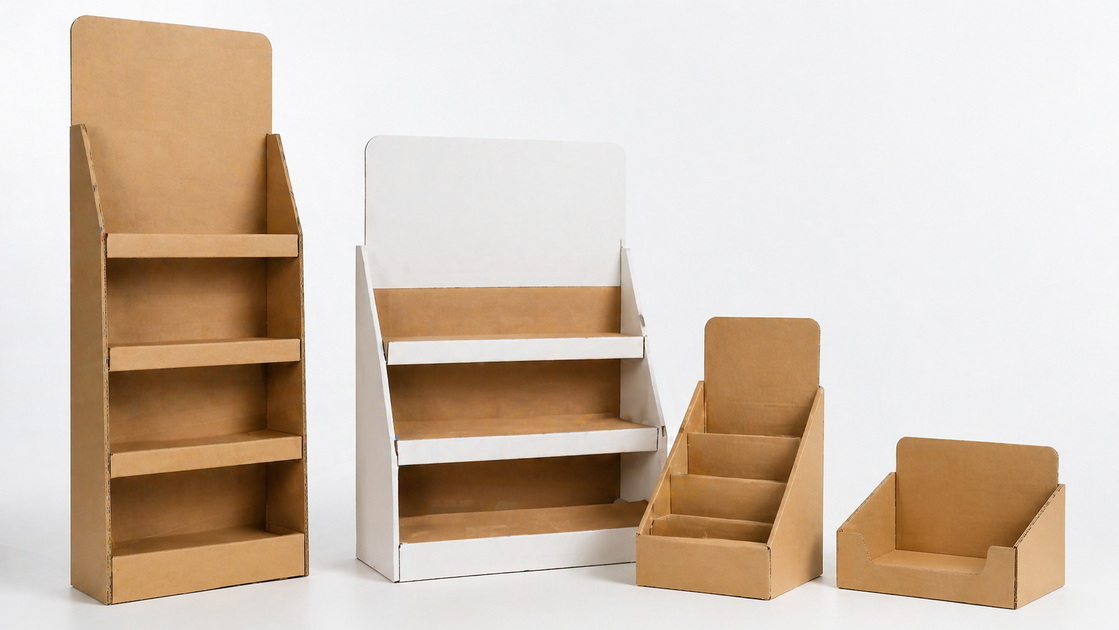
Corrugated cardboard has become the default for many in‑store display programs. It offers a rare combination of visibility, flexibility, cost control, and sustainability that permanent materials struggle to match for short‑term campaigns. [creativedisplaysnow]
Key advantages:
- Cost‑effective production and shipping: Lightweight, flat‑packable, and less expensive than metal or plastic for temporary displays. [grandfly]
- High customization: Size, shape, graphic coverage, and special finishes can all be tuned to the brand and campaign. [popdisplay]
- Easy setup: Many units are designed for quick assembly or pre‑assembly, which is critical for large retail networks. [msl-indy]
- Eco‑friendly image: Recyclability and lower material impact support retailer sustainability initiatives. [creativedisplaysnow]
This is exactly where a specialist POP display manufacturer like Long‑Win Display adds value: we combine structural engineering with printing and pre‑packing to deliver ready‑to‑install POP and POS cardboard solutions for global brands. [longwindisplay]
Based on current retail and packaging trends, several best practices consistently deliver better ROI. Small structural decisions often matter as much as creative artwork. [grandfly]
- Keep top headers above shelf height to break the visual line of standard gondolas. [rochestermagnet]
- Use structural elements (cutouts, side wings) to create a strong silhouette from a distance.
- Design for easy replenishment: large openings, clear product lanes, and space for labels. [nrsplus]
- Ensure stability with proper base design and tested weight capacity. [creativedisplaysnow]
- Prioritize footprint and height so units fit on counters without blocking staff. [repsly]
- Use angled shelves or steps so every product row is visible from above. [nrsplus]
- Make messaging ultra‑short—brand, product name, key benefit, and price if needed. [wowpopdisplay]
- Consider pre‑packed units that can be placed in seconds, not minutes. [creativedisplaysnow]
Many B2B clients ask, "Do I need POP, POS, or both?" You can answer this with a straightforward decision process that aligns with your goals, product, and budget. [zhsunyco]
1. Define your main objective.
- Brand awareness, education, or promoting a new line → prioritize POP.
- Incremental units and basket lift on existing products → prioritize POS. [yodeck]
2. Analyze product characteristics.
- Larger packs, premium sets, multi‑buy offers → work better in POP floor or pallet displays. [nrsplus]
- Small, low‑priced, quick‑decision products → ideal for POS counter units. [nrsplus]
3. Check retailer constraints.
- Available floor space, aisle widths, safety rules, and fixture policies. [msl-indy]
- Checkout policies often strictly limit POS footprint.
4. Plan your shopper journey.
- Map where the shopper first meets the product, where they compare, and where they pay. [insigniasystems]
- Insert POP at key decision points; POS at the final queue.
5. Work with your cardboard display partner.
- Share KPIs, product details, and retailer guidelines with your manufacturer.
- Co‑create a family of displays that can be used across different regions and store formats. [grandfly]
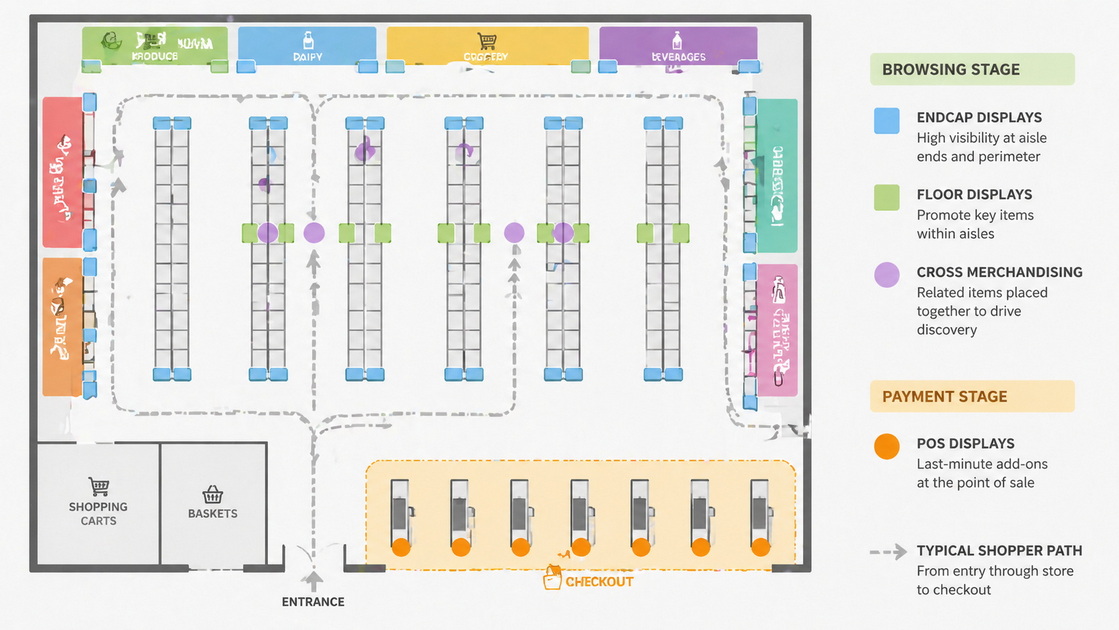
Recent retail case studies show that combining coordinated POP and POS can significantly lift sell‑through. Brands that use both types of displays as one system often report better returns than those using either alone. [grandfly]
Patterns observed across case examples:
- Aligning artwork and structural cues across POP and POS increases recognition and trust. [popdisplay]
- Launch campaigns that start with bold POP islands and are "closed" by POS checkout trays often deliver the highest uplift. [msl-indy]
- Using cardboard for both formats keeps costs manageable so brands can test more variations and optimize faster. [grandfly]
For Long‑Win Display, this translates into modular programs where one base structure can be adapted into multiple POP and POS versions using different headers, shelves, and graphics, reducing tooling costs for B2B clients. [longwindisplay]
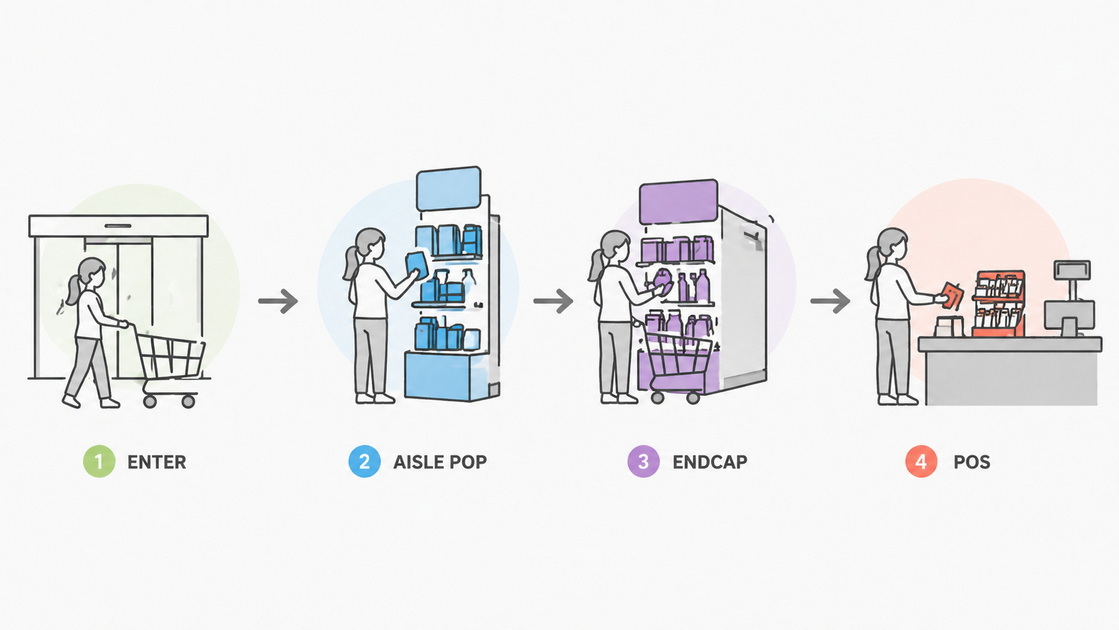
When you stop thinking of POP and POS as isolated projects and start treating them as one connected system, your displays work together to guide, remind, and convert shoppers all along the store journey. [nrsplus]
As a dedicated China POP display manufacturer, Long‑Win Display can:
- Help you define whether POP, POS, or a combination is right for your next campaign.
- Design, customize, and pre‑assemble cardboard POP floor stands and POS counter displays tailored to your retailers and markets.
- Support regional rollouts with cost‑efficient production, packaging, and logistics.
If you are planning your next in‑store program and want your displays to do more than just "look good," contact Long‑Win Display to co‑develop a POP and POS display system that drives measurable retail results.
1. What is the main difference between POP and POS displays?
POP displays are placed throughout the store to influence buying decisions while shoppers browse, whereas POS displays sit at checkout to capture last‑minute impulse purchases. The difference is mainly location and decision stage. [dimensionaldesign]
2. Which is better for launching a new product, POP or POS?
For launches, POP usually delivers more impact because it offers space for product education, sampling, and larger facings. POS is better as a follow‑up touchpoint for quick add‑on purchases once awareness is already built. [nrsplus]
3. Are cardboard POP and POS displays strong enough for heavy retail use?
High‑quality corrugated displays are engineered to support the target weight and withstand busy store environments when designed correctly. They are widely used by global brands because they are durable, lightweight, and cost‑efficient for temporary and semi‑permanent campaigns. [creativedisplaysnow]
4. Can one display be used as both POP and POS?
Sometimes, yes, if the footprint is compact enough and retailer rules allow it. However, most successful programs use purpose‑built POP and POS units optimized for their specific locations, even when they share a common design language. [rochestermagnet]
5. How do I decide how many POP vs POS displays to order?
Consider store size, category importance, and campaign goals. A common pattern is to prioritize more POP units for broad reach and a smaller number of POS units for high‑value or strategic checkouts, then adjust future orders based on sales and traffic results. [zhsunyco]
1. Dimensional Design – "POP vs. POS Displays: What is The Difference?"
https://dimensionaldesign.net/blog/differences-between-pop-vs-pos-displays [dimensionaldesign]
2. Repsly – "POP vs. POS: What is the Difference?"
https://www.repsly.com/blog/point-of-purchase-vs-point-of-sales-difference [repsly]
3. WOW Packaging Display – "POS VS. POP: What Is the Difference?"
https://www.wowpopdisplay.com/resources/pos-vs-pop-what-is-the-difference.html [wowpopdisplay]
4. NRSPlus – "Point of Sale vs. Point of Purchase: What's the Difference?"
https://nrsplus.com/blog/point-of-sale-vs-point-of-purchase/ [nrsplus]
5. Rochester Magnet – "POP vs. POS Displays: What's the Difference?"
https://rochestermagnet.com/blog/entry/pop-vs-pos-displays-whats-the-difference/ [rochestermagnet]
6. Creative Displays Now – "Benefits of Using Corrugated Cardboard for Custom Displays"
https://www.creativedisplaysnow.com/benefits-cardboard-custom-displays/ [creativedisplaysnow]
7. Bennett Packaging – "POP vs POS Display: Which Is Right For Me?"
https://bpkc.com/blogs/blog/pop-vs-pos-display-which-is-right-for-me [bpkc]
8. Zhsunyco – "Mastering Retail Success: POP vs POS Guide"
https://www.zhsunyco.com/pop-vs-pos-for-retail-success/ [zhsunyco]
9. Grandfly – "5 Key Advantages of Cardboard Displays for Retail Success"
https://grandfly.com/5-key-advantages-of-cardboard-displays-for-retail-success/ [grandfly]
10. Yodeck – "Complete Guide to POSM, POP & POS Displays for 2025"
https://www.yodeck.com/use-cases/posm-pos-pop-display/ [yodeck]
11. PopDisplay.me – "How Custom Displays Can Help Capture Your Target Audience?"
https://popdisplay.me/how-custom-displays-can-help-capture-your-target-audience/ [popdisplay]
12. Insignia Systems – "Retail POP & POS Displays"
https://insigniasystems.com/blog/pop-vs-pos-displays/ [insigniasystems]
13. MSL – "Retail POS / POP Packaging and Displays That Sell in 2025"
https://msl-indy.com/retail-pos-pop-packaging-displays/ [msl-indy]
14. Long‑Win Display – Company site
https://www.longwindisplay.com [longwindisplay]


