
Views: 222 Author: Long Win Display Publish Time: 2026-04-19 Origin: Site


In over a decade of designing cardboard POP display stands for global retail brands, I've seen one decision consistently make or break in‑store campaigns: choosing between a sidekick display and an endcap display — and then designing each to match shopper behavior, retailer rules, and brand goals. When this choice is made strategically, a simple corrugated display turns into a mini billboard that moves inventory faster, lifts basket value, and strengthens brand recall. [cardboard-display-stand]
In this guide, I'll walk you through the real‑world difference between sidekick and endcap displays, when to use each, and how to brief your display supplier so you don't waste budget on the wrong structure. The goal is not just to define terms, but to help you plan, test, and scale your cardboard displays like an experienced category manager or trade marketing director. [packwins]
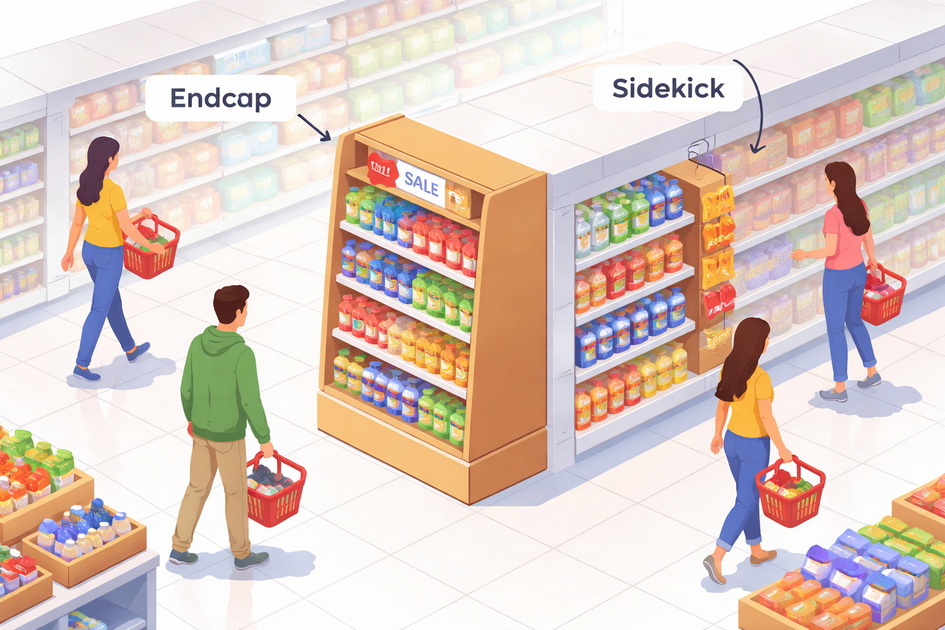
A sidekick display — also called a power wing or sidecap display — is a compact POP unit that usually hangs from the side of a gondola, a pallet, or a wire fixture in high‑traffic areas. Most sidekicks are made from corrugated cardboard, sometimes supported by metal or wire panels for extra strength.
From an operator's perspective, sidekicks are designed to:
- Maximize vertical space on the side of shelves or fixtures
- Trigger impulse purchases in busy zones such as aisle entrances and checkouts
- Test new SKUs or clear older inventory with small, focused quantities
Typical structural options include:
- Shelf‑based sidekicks – for stacked products like boxed snacks or health & beauty items
- Feed‑slide sidekicks – gravity‑fed units that release one product at a time (e.g., trial sachets, small tubes)
- Hook / peg sidekicks – open front with peg hooks for hanging items (razors, batteries, accessories)
Because they are relatively small and lightweight, sidekick displays are highly flexible: they can be hung on shelf sides, mounted on end panel racks, or even used as free‑standing mini‑displays near the register.

An endcap display is the larger POP structure placed at the end of an aisle or near the checkout area, facing the main traffic flow. You'll also hear them called end‑of‑aisle displays or simply endcaps.
Key characteristics of retail endcaps: [grandfly]
- Positioned where shoppers enter or exit the main aisle
- Often linked to the category in that aisle (e.g., cosmetics endcap at the end of the beauty aisle)
- Built to showcase a hero product or a themed collection (e.g., "Back‑to‑School Essentials")
- Constructed from corrugated cardboard or steel, depending on load and campaign duration
The primary goal of an endcap is to spotlight a product or range and capture shoppers who did not actively come in for that brand — effectively turning a passive visit into an incremental purchase. [cardboard-display-stand]
Well‑designed cardboard endcaps function as in‑store billboards: they combine bold branding, clear value messaging, and strategic product placement to drive both trial and trade‑up. [packwins]

Although sidekick and endcap displays share the same POP purpose — attracting attention and boosting sales — they differ in size, placement, shopper interaction, and campaign role. [cardboard-display-stand]
| Dimension | Sidekick Display (Power Wing) | Endcap Display |
|---|---|---|
| Primary Location | Side of shelves, fixtures, or near checkout | End of aisle / main walkway |
| Typical Size | Smaller, narrow footprint | Larger, full‑face display |
| Product Volume | Low–medium quantity (trial, promos) | Medium–high quantity (hero ranges) |
| Shopper Intent | Mostly impulse / add‑on buys | Mix of planned + impulse purchases |
| Flexibility of Placement | Highly flexible; can move easily | Limited to end positions agreed with retailer |
| Ideal Use Cases | New item tests, seasonal add‑ons, small packs | Launches, thematic campaigns, cross‑category bundles (cardboard-display-stand) |
| Material Options | Corrugated cardboard, with wire/basket support | Corrugated cardboard or steel frames |
| Budget Level | Lower cost per unit | Higher, but greater visual impact (grandfly) |
In practical terms:
- If you need high visibility and stocking capacity, an endcap is usually the better fit.
- If you want agile placement and low‑risk testing, a sidekick often delivers better ROI.

Both types of POP displays contribute to sales in three core ways: attention, awareness, and on‑the‑spot conversion. [packwins]
Visually strong POP displays break the "shelf blindness" that many shoppers experience in crowded categories. [packwins]
Effective attention drivers include: [holidaypac]
- Bold brand colors and high‑resolution graphics
- Clear visual hierarchy – hero product at eye level, support SKUs below
- Simple, benefit‑driven headlines ("Whiter teeth in 7 days" vs "New formula")
- Clean layout – no clutter, focus on 3–5 key SKUs per display
Studies in retail design show that color contrast and clear focal points significantly increase the likelihood that a display is noticed and approached, especially in busy supermarkets and pharmacies. [cefbox]
Endcaps and sidekicks act as low‑cost, in‑store media: they put your brand identity directly in front of shoppers at decision time. [cefbox]
Strong displays typically:
- Repeat the brand logo and key visual cues consistently
- Reinforce USP messages (e.g., eco‑friendly, premium ingredients, local sourcing)
- Use QR codes or social media hashtags to connect offline traffic with online channels [blockandtam]
Over time, repeated exposure at prominent in‑store locations supports brand salience, making shoppers more likely to recall and choose you in future trips. [grandfly]
Unlike traditional ads that drive visitors to the store, POP displays operate at the point of decision. When a shopper is already holding a basket, a strong sidekick or endcap:
- Answers basic questions (What is this? Why should I care? How much?)
- Reminds them of limited‑time offers or bundles
- Lower the friction to trial — especially for smaller, affordable items [packwins]
This is why many brand teams treat sidekicks and endcaps as part of their trade marketing and shopper marketing mix, not just as packaging extensions. [grandfly]
From a practical, campaign‑planning perspective, here's how seasoned retail marketers usually decide.
You want to: [grandfly]
1. Test a new SKU
- Place a small quantity in high‑traffic areas to measure pickup without committing full shelf or endcap space.
2. Promote small, affordable items
- Ideal for items shoppers can easily toss into their basket (gum, travel‑size cosmetics, batteries, small snacks).
3. Add impulse opportunities near checkout
- Mount sidekicks around POS or queue areas to capture last‑minute adds.
4. Work within limited budgets
- Corrugated sidekicks are relatively low‑cost, quick to assemble, and easy for staff to move.
You need to: [cardboard-display-stand]
1. Launch a major product or new line
- Use full‑face branding, multiple facings, and storytelling panels to create a mini "shop within a shop."
2. Create seasonal or thematic promotions
- "Back to school," "Summer beauty," or "Lunar New Year snacks" displays work best when you have space for multiple SKUs and bold visuals.
3. Support a retail partner's category strategy
- Endcaps are often negotiated as part of your trade terms; use them to align with the retailer's category roles and planograms.
4. Showcase premium or hero SKUs
- Larger structures allow you to highlight premium packs, bundles, or gift sets attractively.
As a manufacturer specializing in custom cardboard display stands, we see the same patterns across successful campaigns. Below are battle‑tested recommendations you can apply to your next sidekick or endcap project. [cefbox]
Before you brief your designer, clarify:
- Target shopper: age, mission (top‑up shop vs big weekly trip), price sensitivity
- Retail format: convenience store, hypermarket, pharmacy, club store, etc.
- Traffic flow & sightlines: where do shoppers come from and where do they turn?
This context will determine:
- Whether a sidekick is better placed at an aisle entrance or near POS
- Whether an endcap needs strong side panels for longer‑distance visibility
- How high products should be placed (eye level vs reach level) [cardboard-display-stand]
Shoppers rarely give a display more than a couple of seconds of attention. Keep your design:
- Visually simple – one key message, one hero image
- Copy‑light – short, benefit‑driven lines instead of long paragraphs [eway-crm]
- Structured – clear hierarchy from brand → benefit → price / offer
For example, on a beauty endcap:
- Headline: "Hydrated Skin in 7 Days"
- Sub‑headline: "New Hyaluronic Collection – 20% Off This Month"
- Support copy: 1–2 bullet points with core benefits
From a store operations point of view, the perfect display is one that:
- Doesn't collapse or lean even under full load
- Protects product edges and corners
- Allows quick one‑person assembly
- Makes it easy for staff to replenish from the back or sides
Collaborate with your display supplier on:
- Material grade (corrugated flute type and board thickness) based on product weight [grandfly]
- Reinforced load‑bearing areas (e.g., shelf lips, base footprints)
- Clear assembly instructions and minimal loose parts
Retailers are far more likely to approve and reuse displays that feel solid and easy to handle.
The highest‑performing brands don't treat sidekicks and endcaps as either/or. They create a multi‑touch in‑store journey.
A typical approach we see working well: [packwins]
1. Endcap for storytelling & discovery
- New line or hero campaign with full branding, education, and main stock.
2. Sidekicks for impulse reinforcement
- Smaller units near checkout or in secondary locations (e.g., drinks aisle + snacks sidekick) to pick up additional sales.
3. Consistent visual identity
- Use the same key visual, color palette, and core message so shoppers instantly connect the units.
This combination lets you capture attention at multiple points in the store and increase the likelihood of both trial and repeat purchase.
To get a display that truly works in retail — and not just in a design deck — your supplier needs more than a logo file.
Provide, at minimum: [penfriend]
1. Campaign objectives
- Clear goals: "+15% uplift in category sales," "trial for new flavor," "clear old stock."
2. Retailer constraints
- Maximum footprint, fixture type, height limits, safety standards, any standard hook/basket systems used.
3. Product details
- Pack dimensions, weight per unit, expected facings, total stock per display.
4. Promotion mechanics
- Discounts, bundle offers, or loyalty incentives you want highlighted.
5. Timing & logistics
- Required delivery dates, flat‑pack vs pre‑assembled, co‑packing or pre‑loading needs.
A strong brief allows your display manufacturer to recommend the right structure (sidekick, endcap, or hybrid) and engineer it for strength and efficiency from the start.

If you're publishing this article on your website to capture search traffic for "sidekick vs endcap display" and "cardboard POP display stands", you also need to think about user experience and E‑E‑A‑T (Experience, Expertise, Authoritativeness, Trustworthiness). [marketingaid]
Apply these best practices:
- Add an author bio describing your years in POP design and key industries served. [marketingaid]
- Include case snapshots (even anonymized) showing how a sidekick or endcap improved sell‑through or trial.
- Integrate customer testimonials or user comments about your displays' quality and impact. [blockandtam]
Within the article page:
- Use clear H2 / H3 headings and bulleted lists (as in this guide) for fast scanning. [penfriend]
- Bold key decision points such as "Choose a sidekick when…" and "Choose an endcap when…"
- Add a comparison table (like the one above) so users can get the gist in seconds. [johnpaulhernandez]
To increase dwell time and comprehension, consider adding: [blockandtam]
- A diagram showing typical store placement of sidekicks vs endcaps
- Real photos of your past cardboard sidekick and endcap projects
- A short 30–60 second explainer video walking through a real display in a store
Place visuals:
- After the definitions section (to show what each display looks like)
- Near the comparison table (to illustrate size and placement differences)
- In the advanced strategy section (to visualize how multiple displays work together)
If you're planning a new retail launch or looking to upgrade your in‑store visibility, partnering with a specialist cardboard POP manufacturer will save you weeks of trial and error.
At Long Win Display, our team designs, customizes, produces, and pre‑packs:
- Sidekick / power wing displays for impulse and trial
- Cardboard endcap displays for high‑impact category campaigns
- A full range of corrugated retail POP stands tailored to your brand and retailer requirements
Whether you already have a concept or are starting from a blank page, we can help you choose the right structure, engineer it for strength, and optimize it for shopper behavior.
Ready to turn your next cardboard display into a true sales engine?
Contact our team for a free structural consultation and quotation on your sidekick or endcap project.
1. Are sidekick displays always made of cardboard?
Most sidekick displays in supermarkets and pharmacies use corrugated cardboard because it is cost‑effective, lightweight, and easy to customize. However, many retailers support them with metal or wire baskets to increase stability. [packwins]
2. When should I upgrade from a sidekick to an endcap?
Consider an endcap when you:
- Need to stock larger quantities
- Are running a major launch or seasonal campaign
- Have negotiated prominent positions with the retailer [cardboard-display-stand]
3. Can I reuse a cardboard endcap for multiple campaigns?
In many cases, yes — if you design the structure with neutral branding and use replaceable graphic elements (e.g., sleeves, headers, interchangeable panels). This allows you to refresh visuals while keeping the same core structure. [grandfly]
4. How do I measure the ROI of sidekick or endcap displays?
Common metrics include sales uplift vs control stores, sell‑through speed, additional units per transaction, and campaign duration before stock‑out. You can also track coupon redemptions or QR code scans tied to the display. [cefbox]
5. What information should appear on the display itself?
Focus on:
- Clear brand and product name
- 1–2 benefit‑oriented messages
- Price or promo details (if applicable)
- Optional QR code or hashtag for extended engagement [holidaypac]
1. Creative Displays Now – Sidekick Display vs. Endcap Display – What's the Difference?https://www.creativedisplaysnow.com/difference-sidekick-display-endcap-display/
2. Packwins – The Complete Guide to Corrugated Retail POP Displayhttps://packwins.com/the-complete-guide-to-corrugated-retail-pop-display/
3. CEF Box – Cardboard Display Box Strategies To Maximize Trade Show Engagementhttps://www.cefbox.com/blog/knowledgeBase/Cardboard-Display-Box-Strategies-To-Maximize-Trade-Show-Engagement
4. Grand Fly – How to Choose the Right Cardboard Displays for Your Businesshttps://grandfly.com/a-buyers-guide-to-choosing-the-right-cardboard-displays-for-your-business/
5. Marketing Aid – Ultimate E-E-A-T Guide for 2024https://www.marketingaid.io/ultimate-eeat-guide/
6. eWay CRM – How to Apply E-E-A-T Principle in Your Contenthttps://www.eway-crm.com/blog/sales-marketing/information-is-now-a-commodity-google-is-focused-on-e-e-a-t-and-we-can-see-why/
7. Penfriend – Guide To Create Product Comparison Content That Convertshttps://penfriend.ai/blog/product-comparison-content
8. Cardboard-Display-Stand.com – Retail Revolution: The Complete Guide To Effective Endcap Displayshttps://www.cardboard-display-stand.com/news/retail-revolution-the-complete-guide-to-effec-85274024.html
9. Block & Tam – E-E-A-T Guide: Creating Helpful Content For Luxury Brandshttps://www.blockandtam.com/insights/e-e-a-t


