
Views: 230 Author: Long Win Display Publish Time: 2026-11-04 Origin: Site


Content Menu
● What Makes Cosmetic Packaging the Best Choice?
● Understand the Three Layers of Cosmetic Packaging
>> Primary Packaging: Protect the Formula
>> Secondary Packaging: Protect and Explain the Product
>> Transit and Display Packaging: Complete the Journey
● Which Cosmetic Packaging Materials Should You Choose?
>> Is Glass Always Better for Premium Cosmetics?
>> What Is the Best Plastic for Cosmetics?
● Validate Formula Compatibility Before Approving the Box
>> Use Production-Representative Samples
● How to Design Custom Cosmetic Boxes for Retail
>> Build a Clear Information Hierarchy
>> Match the Box to the Retail Footprint
● Choose Shipping Protection That Matches the Distribution Route
>> Specify the Test Instead of Saying "Drop Tested"
● Sustainable Cosmetic Packaging: Make Specific, Verifiable Choices
>> Review Environmental Claims Before Printing
● Compare Total Packaging Cost, Not Just the Quotation
● A Practical Approval Workflow for Beauty Brands
>> 1. What Is the Best Packaging for Skincare Products?
>> 2. Do All Cosmetics Need an Outer Box?
>> 3. Are Airless Pumps Better Than Droppers?
>> 4. Can Cosmetic Packaging Be Recyclable?
>> 5. What Should I Send a Custom Cosmetic Packaging Manufacturer?
The best packaging for cosmetics is a system, not a single material. It combines a formula-compatible container, a protective custom cosmetic box, reliable shipping protection, and a retail presentation that helps customers understand the product.
For beauty brands, these decisions are connected. A premium glass bottle can disappoint if it leaks during delivery. A beautiful carton can underperform if its label is difficult to read or its dimensions waste valuable shelf space.
At Long Win Display, our perspective connects custom packaging boxes with point-of-purchase displays. We recommend evaluating how packaging performs throughout its journey: filling, packing, shipping, stocking, purchasing, and everyday use.
This guide explains how to make those choices without paying for features your product does not need.

Before comparing materials, define what success means for your product.
A useful packaging brief answers five questions:
- What protection does the formula require?
- How will customers dispense and use it?
- Where will the product be sold?
- What information must the packaging communicate?
- What is the acceptable total cost per sellable unit?
There is no universal winner between glass, plastic, and paperboard. Each serves a different purpose.
For example, a facial serum may require a protective dispensing system, while a powder compact needs secure closure and resistance to handling damage. Their outer boxes must then accommodate those different structures.
Start with product performance. Develop the visual experience around it.
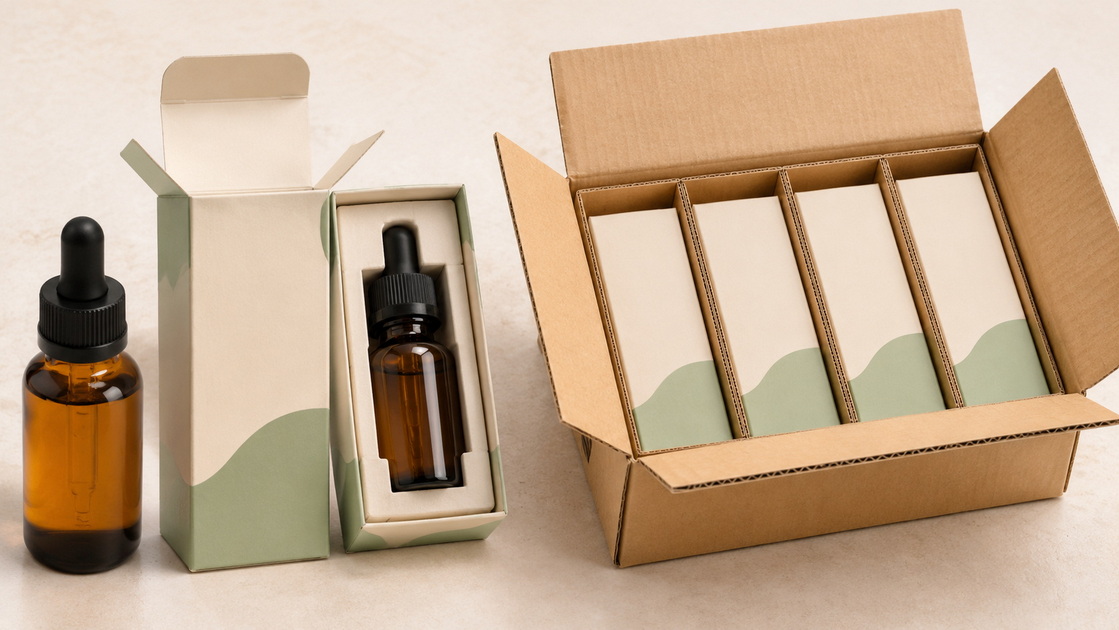
Primary packaging directly contains the cosmetic. Common formats include bottles, jars, tubes, pumps, droppers, compacts, and sachets.
Its suitability depends on the complete packaging system—not simply the resin or glass specification. Closures, liners, seals, pumps, and contact components also matter.
A container that works for one formula may not work for another.
Custom cosmetic packaging boxes organize the presentation, provide space for required information, and can help protect the primary container.
Folding cartons suit many individual products. Rigid boxes can support gift sets and premium presentations. Sleeves offer additional branding but generally provide less enclosure than a complete carton.
An outer box cannot correct an incompatible bottle or unreliable closure.
Shipping cartons, dividers, inserts, and retail displays perform different jobs.
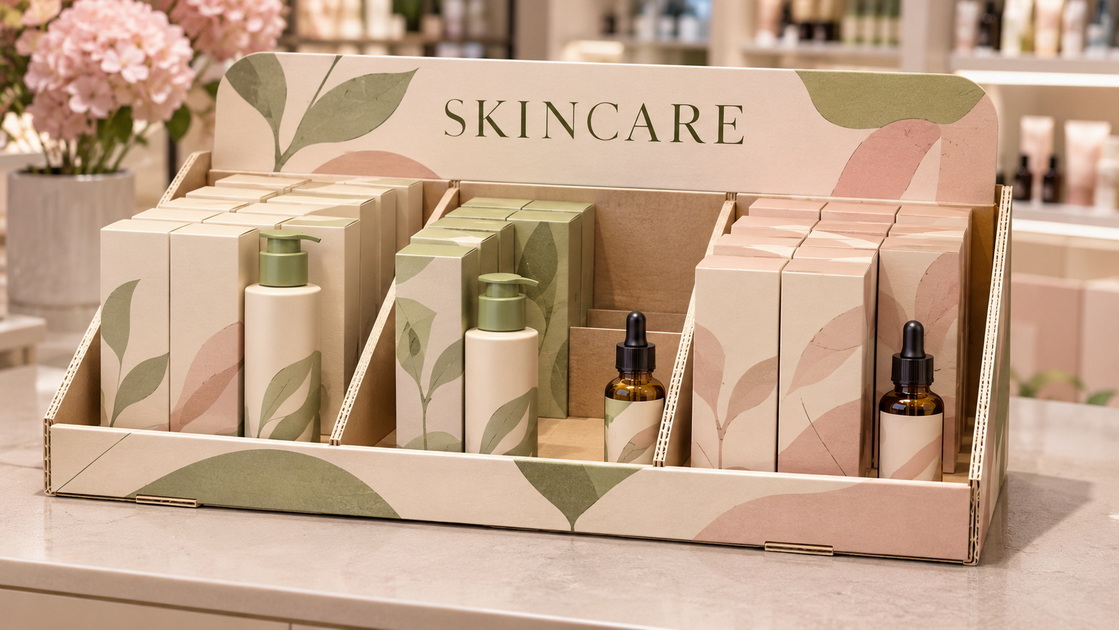
A shipping carton protects during distribution. A shelf-ready tray can organize products and simplify replenishment. A POP display presents the range within a defined retail footprint.
Design these layers together so products fit securely without unnecessary packaging.
Use this table to create an initial shortlist, not a final specification.
| Material or format | Potential application | Main consideration |
|---|---|---|
| Glass | Serums, oils, premium skincare | Weight, breakage, closure performance, and light protection |
| PET | Bottles and selected jars | Formula compatibility, decoration, and local recycling acceptance |
| PP | Caps, jars, and dispensing components | Component fit, dispensing performance, and appearance |
| HDPE or LDPE | Squeeze bottles and flexible formats | Formula interaction, permeability, and dispensing control |
| Paperboard | Folding cartons and sleeves | Structural strength, print quality, and coating selection |
| Corrugated board | Shippers, trays, and displays | Compression, moisture exposure, and distribution conditions |
| Rigid board | Gift boxes and presentation sets | Material use, assembly, storage, and freight volume |
No. Glass can support a premium presentation, but it also introduces weight and breakage considerations.
Clear glass does not automatically provide suitable protection for a light-sensitive formula. The selected glass, decoration, closure, and storage conditions still require evaluation.
Judge premium packaging by its complete experience: protection, dispensing, handling, appearance, and disposal.
There is no single best plastic for every cosmetic product.
Ask suppliers to identify the exact material grade and all product-contact components. Then evaluate those components with the actual formula.
Changing from virgin resin to post-consumer recycled material should also trigger a specification review. Do not assume an earlier approval covers every subsequent material change.
This is one of the most important steps in cosmetic packaging development.
Compatibility testing examines both directions of interaction: how the formula affects the package and how the package affects the formula.
Potential problems include discoloration, odor changes, swelling, cracking, leakage, and inconsistent dispensing.
Test the intended bottle, closure, liner, pump, and other contact components together.
A stock sample with a different seal or pump is useful for early screening, but it is not equivalent to the final commercial package.
Your formulation team or qualified laboratory should define suitable conditions and acceptance criteria.
A practical evaluation plan may include:
1. Formula color, odor, texture, and physical stability.
2. Package deformation, cracking, or surface changes.
3. Closure integrity and leakage.
4. Dispensing consistency throughout use.
5. Performance in relevant storage orientations.
6. Microbiological considerations where appropriate.
Airless packaging may be worth evaluating, but it does not automatically establish shelf life or eliminate preservation requirements.
Finalize the outer box around the validated container dimensions.
An effective cosmetic box helps customers identify the product while fitting the realities of the shelf.
The front panel should make the product understandable without forcing shoppers to search.
A practical hierarchy is:
- Brand and product name.
- Product type or function.
- Variant, shade, or size.
- A concise, supportable benefit statement.
- Required quantity information.
Keep decorative elements from competing with essential information.
In the United States, cosmetic labeling requirements address product identity, net quantity, ingredients, business information, and applicable warnings. Placement requirements vary by statement and packaging configuration.
Have the final artwork reviewed for the intended market before printing.
Confirm shelf height, depth, product facings, barcode position, and retailer requirements early.
For display projects, we recommend reviewing the product box and tray together. A tray wall should retain the product without hiding its name or making removal awkward.
Test both a fully stocked display and a nearly empty one. Product access, stability, and replenishment can change as stock sells through.
Retail replenishment and direct-to-consumer delivery expose packages to different handling conditions.
A decorative folding carton should not be expected to perform like a shipping carton.
| Distribution route | Design priorities |
|---|---|
| Parcel delivery | Impact protection, movement control, and closure integrity |
| Palletized retail shipment | Compression resistance, stacking, and load stability |
| Prepacked retail display | Product retention, transit protection, and store readiness |
| Mixed gift set | Separation between components and protection against scuffing |
A useful test report identifies the procedure, package configuration, conditioning, results, and acceptance criteria.
ISTA Procedure 3A addresses individual packaged products shipped through parcel delivery systems, within its stated scope. It is not automatically the correct procedure for every pallet shipment or prepacked display.
Select testing that represents the actual route.
When a failure occurs, identify the cause before adding material. A better insert, revised orientation, or improved closure may solve the problem more efficiently than a larger box.
"Sustainable" is too broad to function as a purchasing specification.
Translate it into measurable decisions:
- Remove unnecessary components.
- Reduce avoidable empty space.
- Specify documented recycled content where appropriate.
- Evaluate coatings, laminates, windows, and adhesives.
- Check recycling availability in the destination market.
- Maintain adequate product protection.
Neither paper-based construction nor a recycling symbol proves that a complete package is widely recyclable.
In the United States, environmental marketing guidance calls for qualifying recyclable claims when appropriate facilities are not available to at least 60% of consumers or communities where the item is sold.
A claim should also identify what it describes. A recyclable carton does not make its enclosed pump recyclable.
For EU sales, the Packaging and Packaging Waste Regulation began applying on a phased basis from August 12, 2026. Important requirements have later implementation dates.
Build a market-specific compliance review into development rather than assuming every requirement started simultaneously.
A low unit price can hide costs elsewhere.
Compare quotations using the same dimensions, materials, artwork, order quantity, packing method, and delivery terms.
Then consider:
Total packaging cost = components + tooling + assembly + freight + storage + expected damage and rework.
For example, a larger presentation box may increase freight and warehouse requirements even when its purchase price appears competitive.
Likewise, flat-packed displays and preassembled displays solve different operational problems. Flat packing can reduce shipping volume; preassembly can reduce work at the destination. The better choice depends on where labor, space, and time are constrained.
Ask suppliers to separate one-time charges from recurring costs.
Use a staged process to reduce expensive late changes.
1. Define the product, destination markets, sales channels, budget, and launch date.
2. Shortlist primary packaging with the formulation team.
3. Validate compatibility and dispensing.
4. Develop the carton, insert, shipper, and display around confirmed dimensions.
5. Review label content, structural samples, and print proofs.
6. Test filled, production-representative packaging.
7. Approve a reference sample and document inspection criteria.
Before placing the order, confirm component ownership, tolerances, approved substitutions, artwork version, and change-control responsibilities.
These details make repeat production easier to evaluate and help prevent an attractive prototype from becoming an inconsistent commercial product.
Choose packaging that passes compatibility and performance testing with the actual formula. Bottles, tubes, jars, and dispensing systems can all work. The right choice depends on formula requirements, intended use, distribution, and customer expectations.
No. The decision depends on protection, required information, retail presentation, and market rules. Some products can use a well-designed container label. Others benefit from a carton for additional information, organization, or protection.
Not universally. Compare dosing, usability, formula compatibility, leakage, and performance throughout the product's life. Select the system through testing rather than treating "airless" as a guarantee of superior stability.
Some components can be recyclable where suitable collection and processing systems exist. Evaluate the complete format, including closures, pumps, decorations, and material combinations. Use destination-specific claims rather than assuming universal acceptance.
Provide product dimensions and weight, physical samples when available, order quantity, artwork, target market, distribution route, and retailer specifications. Include any requirements for inserts, gift sets, preassembly, or matching retail displays.
1. [Long Win Display — "What Is the Best Packaging for Cosmetics?"]
Original article used as the editorial starting point for packaging layers, material comparisons, transit protection, and display integration. Unverified anecdotes and numerical performance claims were not carried forward. [popdisplay]
2. [Cosmetics Europe / CTFA — "Guidelines on Stability Testing of Cosmetic Products," 2004]
Technical foundation for product–container compatibility, stability evaluation, production-representative packaging, and relevant storage conditions. This is established technical guidance, not a newly published study. [cosmeticseurope]
3. [Cosmetics Europe — "Explanatory Note: General Approach for Cosmetic Packaging," June 2019]
Supports consideration of packaging composition, technical performance, product compatibility, and filling-line requirements. [cosmeticseurope]
4. [U.S. Food and Drug Administration — "Cosmetics Labeling Guide"]
Detailed guidance on cosmetic identity statements, net quantity, ingredients, and information placement across immediate and outer packaging. [fda]
5. [International Safe Transit Association — "Test Procedures"]
Explains distribution-testing procedures, including the parcel-delivery application of Procedure 3A. [ista]
6. [International Safe Transit Association — "Procedure 3A Overview"]
Defines the procedure's scope for individual packaged products weighing 150 pounds / 70 kilograms or less when prepared for parcel shipment. [ista]
7. [Federal Trade Commission — "Environmental Claims: Summary of the Green Guides"]
Supports qualification of recyclable claims, the 60% availability threshold, and clear identification of the component covered by an environmental claim. [ftc]
8. [European Commission — "New EU Rules on Packaging Enter into Application," August 11, 2026]
Confirms phased application beginning August 12, 2026, with significant circular-economy requirements applying later. [environment.ec.europa]


