
Views: 260 Author: Long Win Display Publish Time: 2026-09-22 Origin: Site


Content Menu
● What Is the Main Difference Between a Walmart Pallet Display and a Club Store Display?
● Walmart Pallet Display Design: Built for Visibility and Retail Efficiency
>> Walmart Pallet Display Priorities
>> The "Five Easies" Matter for Walmart Programs
● Club Store Display Design: Engineered for Bulk, Load Capacity, and Value
>> Club Store Display Priorities
>> Why Multi-Side Shoppability Is Important
● Walmart Pallet Display vs Club Store Display: Structural Engineering Comparison
>> A Practical Engineering Rule
● Bulk Promotion Messaging: What Each Shopper Needs to See
>> Club Store Shopper Messaging
● Display Lifecycle: From China Factory to Retail Floor
>> Design for the "Last 10 Feet"
● Choosing the Right Format for Your Promotion
>> Best Applications for Walmart Pallet Displays
>> Best Applications for Club Store Displays
● FAQ
>> 1. What is a Walmart pallet display?
>> 2. What is a club store display?
>> 3. Can one pallet display design work for Walmart and Costco?
>> 4. What materials are best for a bulk product pallet display?
>> 5. How can a pallet display reduce retail labor?
For brands planning bulk product promotions, the choice between a Walmart pallet display and a club store display is not simply a matter of changing graphics or increasing product quantity. The two formats serve different retail environments, shopper missions, replenishment systems, and operational expectations.
At Long Win Display, we approach pallet display programs as an integrated retail-execution challenge: the unit must survive international shipping, move efficiently through distribution, meet retailer-specific handling needs, remain stable on the sales floor, and make the value proposition instantly clear to shoppers. A well-designed POP display does all of those jobs at once.
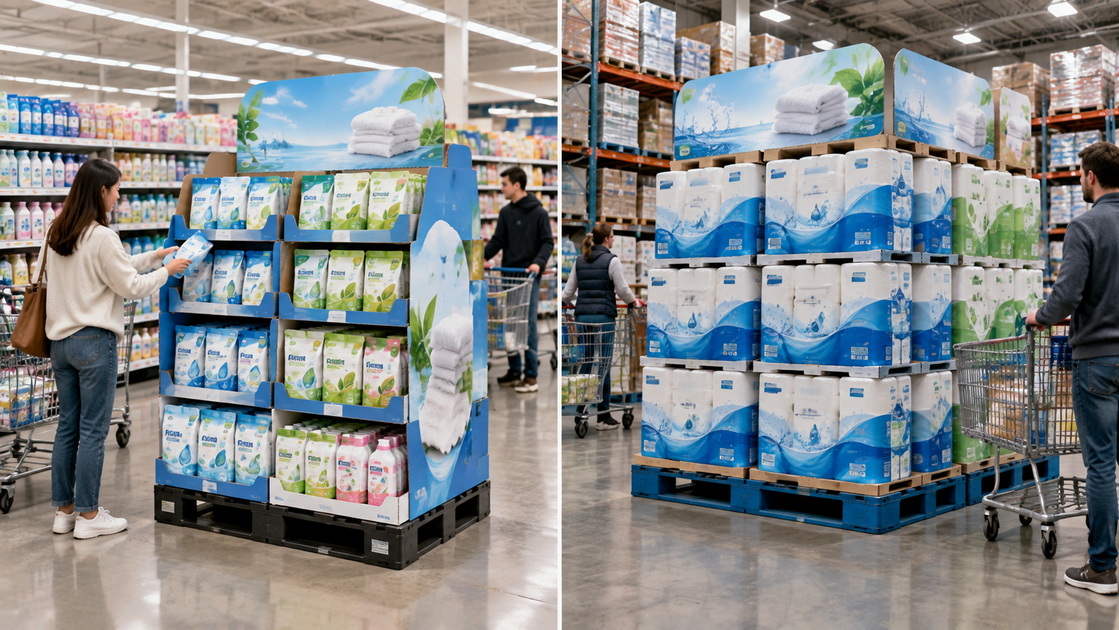
The core difference is retail context.
A Walmart pallet display is often designed for a mass-merchandise environment where products compete for attention near aisles, endcaps, action alleys, seasonal zones, or promotional locations. The display must balance shopper appeal with efficient stocking, manageable product access, visual clarity, and compatibility with store operations.
A club store display, by contrast, is usually built for a warehouse-format environment such as Costco, Sam's Club, or BJ's Wholesale Club. It is designed around bulk purchasing, larger pack sizes, higher load weights, faster pallet-level replenishment, and shopping from multiple sides.
| Comparison Area | Walmart Pallet Display | Club Store Display |
|---|---|---|
| Primary retail environment | Mass retail, big-box aisles, endcaps, promotional zones | Warehouse clubs and membership-based bulk retail |
| Typical shopper mission | Everyday replenishment, discovery, promotion-driven purchase | Stock-up shopping, value comparison, bulk purchase |
| Product pack format | Single units, multipacks, smaller case packs, promotional bundles | Larger multipacks, club packs, high-volume bundles |
| Display emphasis | Brand visibility, clear navigation, easy product selection | High capacity, value communication, multi-side access |
| Product access | Often front-facing or aisle-facing | Usually accessible from three or four sides |
| Structural priority | Retail presentation plus operational efficiency | Heavy-duty strength, pallet stability, warehouse handling |
| Graphic strategy | Category navigation, benefit claims, promotion messaging | Pack count, savings, value-per-unit, bulk-use message |
| Replenishment model | Store associates may replenish units or modules | Often replenished as complete palletized loads |
| Best use cases | Seasonal promotions, new product launches, impulse conversion | High-volume essentials, bulk bundles, warehouse promotions |
The important takeaway is this: a club store display should not be treated as an oversized Walmart display. It needs different structural engineering, product-access planning, and value communication.
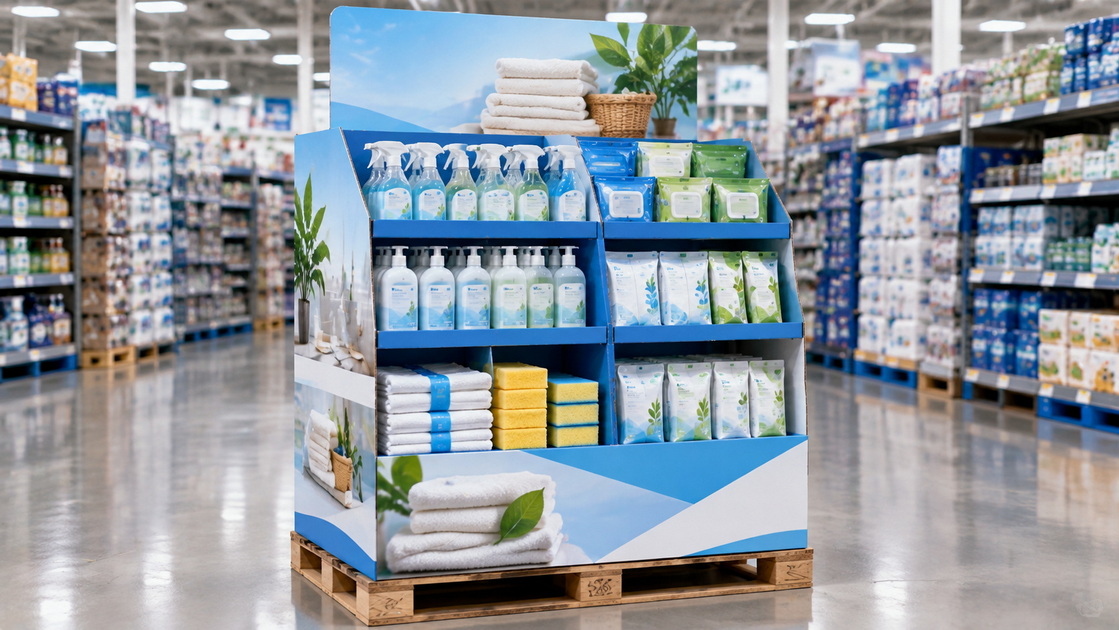
A Walmart pallet display must work hard in a visually crowded environment. Shoppers may see it while walking through a main aisle, entering a department, browsing a seasonal category, or passing an endcap. Therefore, the display needs to communicate its message quickly.
In our experience designing custom POP displays for retail programs, the strongest Walmart-oriented pallet displays make three things obvious within seconds:
- What the product is
- Why the shopper should care
- What action or offer makes it worth buying now
For example, a pallet display for household cleaning products may need to communicate "plant-based," "refill value," "bonus size," or "limited-time savings" at a glance. If the shopper must read dense packaging copy to understand the offer, the display is doing too little work.
A successful Walmart pallet display typically requires the following elements:
- Strong visual blocking to make the display recognizable from a distance.
- Clear product-facing orientation so shoppers can identify the SKU quickly.
- Easy-to-shop trays or shelves that prevent products from becoming disorganized.
- Retail-ready packaging that reduces labor during stocking.
- Accurate barcodes and visible product information for distribution and store handling.
- Stable, transport-ready construction that protects the display before it reaches the floor.
- Efficient material use to reduce cost and support sustainability objectives.
Walmart's supplier and fulfillment guidance emphasizes that pallets must be accessible to standard pallet jacks, in good condition, and protected for handling. For Walmart Fulfillment Services shipments, the published guidance specifies 40-inch × 48-inch, four-way-access, solid-wood GMA Grade A pallets, with a maximum pallet weight of 2,100 lb and a maximum height of 72 inches including the pallet. These are fulfillment requirements rather than universal in-store display specifications, so suppliers should always confirm the exact program requirements with the retailer and buyer before production./WFS%20basics/WFS-routing-guide-overview)
Retail-ready packaging principles are especially valuable for Walmart-oriented displays. A widely used framework is the Five Easies:
1. Easy to Identify
Product details and barcodes should be visible to warehouse and store teams.
2. Easy to Open
Associates should be able to remove protective packaging without struggling with unsafe or complicated opening steps.
3. Easy to Stock
The display or tray should move rapidly from shipping configuration to selling configuration.
4. Easy to Shop
Shoppers should see, reach, and select products without digging through a messy assortment.
5. Easy to Dispose of
Materials should be practical to break down, recycle, or remove after the promotion ends.
For a display manufacturer, this means the design process cannot begin with a visual rendering alone. It should start with the product dimensions, case pack, target retail location, pallet footprint, expected replenishment method, and transportation route.
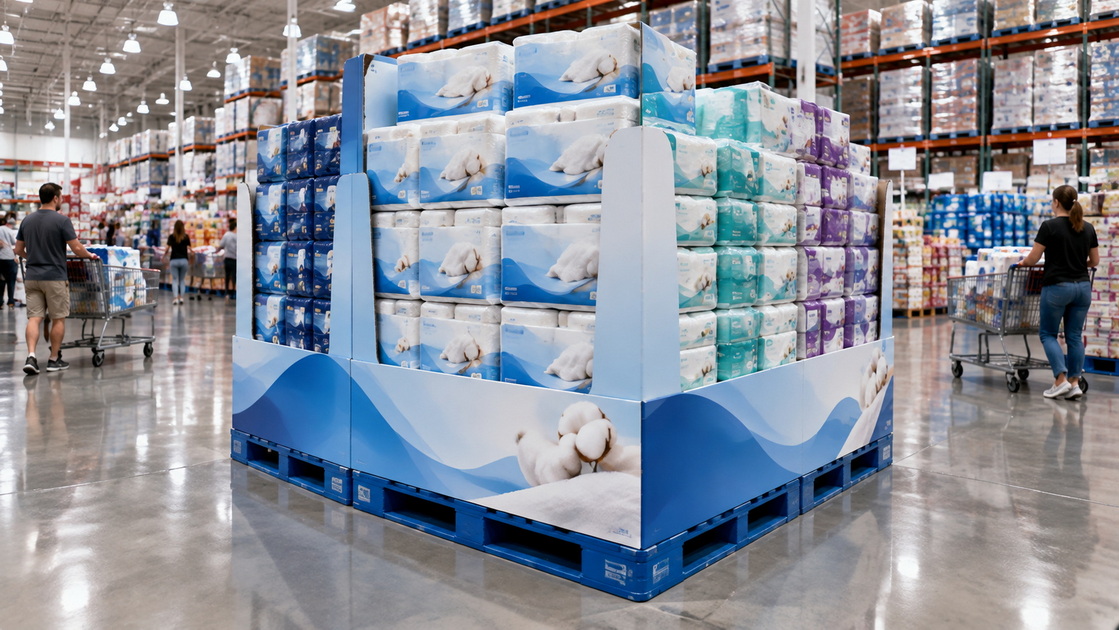
A club store display is designed for a different shopper mindset. In warehouse club retail, shoppers are more likely to compare bulk quantity, per-unit value, pack count, family-use convenience, and product durability. The retail environment is also physically different: wider aisles, taller ceilings, larger carts, palletized inventory, and more open warehouse-style merchandising.
That environment changes the display brief.
A club store display must usually carry more product, support heavier packs, withstand more demanding pallet handling, and remain shoppable from several directions. The display may be placed in an open promotional zone where shoppers approach from the front, side, or rear. A front-only structure can waste selling opportunities.
For bulk product promotions, a club store display should prioritize:
- Heavy-duty corrugated construction or reinforced mixed-material structures.
- High load-bearing performance for larger multipacks and heavier consumer units.
- Three-sided or four-sided shopper access where the placement allows it.
- Minimal dead space that reduces the number of sellable units on the pallet.
- Clear bulk-value messaging visible from a longer distance.
- Fast pallet-level replenishment without requiring store associates to rebuild the display.
- Strong product containment during forklift movement, distribution-center stacking, and store-floor handling.
- Large-format graphics that remain visible in a warehouse-scale environment.
A reliable club-store display often functions as both a shipping unit and a selling unit. That dual role is critical. The display must be engineered to protect the product during the supply chain while presenting the product directly to members on the floor.
Industry packaging guidance distinguishes "club packs" from ordinary retail packs because club packs are oversized consumer-ready packs sold in bulk and commonly need stronger corrugate and more careful palletization.
In a warehouse club setting, shoppers frequently approach a pallet display from more than one direction. If only the front panel communicates the offer, the display loses impact when viewed from the side or back.
For this reason, our display-development team recommends designing club-store pallet displays around a 360-degree selling plan:
- Put the core value claim on every visible side.
- Keep product labels readable from multiple angles.
- Use a consistent color block to make the pallet recognizable.
- Avoid deep, difficult-to-reach product wells.
- Ensure the display still looks intentional after 25%, 50%, and 75% of products have sold.
This final point is often overlooked. A display may look excellent when fully loaded but become visually weak as inventory drops. Designing for the "half-sold" condition helps preserve retail impact throughout the promotion.
The display structure should match the product weight, transportation conditions, retail floor location, and replenishment plan. Using the same structural design for both channels can create unnecessary cost, product damage risk, or retail-compliance issues.
| Structural Factor | Walmart Pallet Display | Club Store Display |
|---|---|---|
| Corrugated requirement | Often medium to heavy-duty corrugated, based on product weight and display design | Frequently heavy-duty corrugated, reinforced corners, higher compression strength |
| Load-bearing demand | Moderate to high, depending on product category and display height | High to very high due to larger packs and higher pallet load |
| Product containment | Trays, shelves, side panels, dividers, display-ready cases | Strong trays, sidewalls, retention features, reinforced product zones |
| Display access | Front or two-sided access may be sufficient | Three-sided or four-sided access is commonly preferred |
| Shipping protection | May use outer cartons, stretch wrap, corner boards, top caps | Often requires stronger self-supporting structure for palletized transit |
| Replenishment | May involve tray replacement or unit stocking | Usually designed for full-pallet replenishment |
| Graphics | Promotional, category-led, brand-led | Value-led, high-contrast, large-format |
| Failure risk | Poor shopper navigation or messy product presentation | Collapse, shifting, crushing, difficult product access |
Before approving artwork, create a structural brief that answers these questions:
1. What is the gross weight of each consumer unit?
2. How many units will be loaded per display?
3. What is the total pallet weight?
4. Will the display be double-stacked during transit?
5. Will it move by forklift, pallet jack, conveyor, or manual handling?
6. Does the product need protection from compression, vibration, moisture, or impact?
7. Will the retail team remove stretch wrap before placing the unit on the floor?
8. How should the display look when partially sold down?
This early-stage discipline prevents a common problem: a visually attractive display that fails during shipping or becomes difficult to shop in-store.
For palletized shipments to Walmart Fulfillment Services, Walmart instructs sellers to use corner boards and stretch wrap for double-stacked pallets, and to ensure forklift access from the same side. Those operational details illustrate why display design and logistics planning must be developed together./WFS%20basics/WFS-routing-guide-overview)
The customer is not the same in both environments, so the display message should not be the same either.
A Walmart shopper may respond to:
- Limited-time promotion
- New product benefit
- Everyday value
- Seasonal need
- Convenient multipack
- Family-friendly solution
- Simple comparison claim
Examples of effective Walmart pallet display headlines include:
- "New: Powerful Clean in Every Spray"
- "Bonus Pack—More for Your Money"
- "Stock Up for Back-to-School"
- "Limited-Time Seasonal Favorite"
- "Easy Meals for Busy Weeknights"
The message should be direct. Avoid forcing shoppers to decode technical product benefits from small copy.
A club-store shopper typically evaluates the product through a bulk-value lens. The display should answer practical questions quickly:
- How many units are included?
- What is the savings or value proposition?
- How long will this supply last?
- Is the bulk pack convenient for a family, office, business, or event?
- What makes this larger purchase worthwhile?
Examples include:
- "36-Pack Family Value"
- "Warehouse Value: More Uses Per Pack"
- "Member-Sized Savings"
- "Stock Up and Save"
- "Bulk Convenience for Home and Business"
The strongest club store display graphics make the pack count, core benefit, and value message readable from a distance. In large warehouse environments, small retail-style packaging graphics are rarely enough.

For Chinese POP display manufacturers and global suppliers, the biggest advantage comes from managing the entire display lifecycle, not merely producing corrugated components.
At Long Win Display, a pallet display project should be evaluated across five connected stages:
1. Concept and retail strategy
Confirm the channel, retail location, shopper profile, promotional period, product assortment, and value proposition.
2. Structural design and prototyping
Build the display around product dimensions, pack count, loading pattern, pallet footprint, and expected retail access.
3. Transit and load testing
Review compression risk, movement during transportation, stacking conditions, stretch-wrap strategy, and moisture exposure.
4. Pre-assembly and co-packing
Pre-load products into trays or display modules when appropriate, reducing work for retail associates and improving display consistency.
5. Retail execution review
Check the finished display before shipment for graphic accuracy, barcode visibility, product-facing quality, structural integrity, and buyer requirements.
This process is particularly important for overseas supply chains. A design that looks correct in a factory mock-up may fail after ocean freight, container loading, distribution-center handling, or store-level merchandising if its structural and operational assumptions were incomplete.
A display is often judged by what happens in the final 10 feet before the shopper reaches it.
From that distance, the shopper should understand:
- The product category
- The brand or product family
- The promotion or value message
- The product pack format
- Where to reach for the product
If these details are not obvious, stronger printing alone may not solve the problem. The display may need better hierarchy, a larger header, more contrast, a simpler claim, or a more open product-facing design.
Choose a Walmart pallet display when your promotion depends on strong retail storytelling, easy selection of smaller or medium-sized packs, seasonal visibility, new-product awareness, or flexible placement in mass retail.
Choose a club store display when your product is sold in bulk, the pack is heavy or large, the value message is central to conversion, pallet-level replenishment is expected, and shoppers need access from multiple directions.
- New product launches
- Holiday and seasonal promotions
- Beauty and personal-care bundles
- Snacks and beverages
- Household cleaning products
- Toys and licensed promotions
- Back-to-school and event-driven displays
- Paper products
- Bottled beverages
- Bulk food and snacks
- Large home-care packs
- Pet food and pet supplies
- Health and wellness multipacks
- Family-size personal-care products
- Business-use or office-use consumables
The best solution may also be a modular platform: one structural system designed with channel-specific graphics, tray depth, pack count, and reinforcement. This can reduce development time while allowing a brand to maintain different retail strategies for Walmart and club-store accounts.
A Walmart pallet display should be designed to win attention and simplify the purchase decision. A club store display should be designed to prove bulk value, carry heavier inventory, and remain shoppable at warehouse scale.
For brands entering multiple North American retail channels, the safest approach is to develop each display around the actual retailer brief, product configuration, pallet requirements, logistics route, and store execution model. Do not assume one successful display format can be copied directly into another retail environment.
Long Win Display can support this process from POP display concept development and structural engineering to custom production, pre-assembly, quality control, and export-ready packaging. Whether you need a Walmart pallet display for a seasonal retail program or a club store display for high-volume bulk promotions, the goal is the same: deliver a display that arrives safely, meets retail expectations, and makes the product easier to buy.
A Walmart pallet display is a retail-ready promotional display built on a pallet base or designed around a pallet footprint. It is used to present products in high-traffic locations such as action alleys, endcaps, seasonal areas, and promotional aisles. The design usually emphasizes product visibility, easy shopping, fast stocking, and clear promotional communication.
A club store display is a palletized retail display designed for warehouse clubs such as Costco, Sam's Club, and BJ's Wholesale Club. It typically holds larger consumer packs or bulk multipacks and requires stronger structural support, larger value messaging, and multi-side shopper access.
Sometimes, but it is rarely ideal without modifications. Walmart and club-store environments differ in shopper behavior, product pack size, display access, handling conditions, and value communication. A shared base structure may be possible, but the graphics, reinforcement, product layout, and merchandising strategy should be tailored to each channel.
Heavy-duty corrugated cardboard is commonly used because it is printable, customizable, recyclable, and cost-effective. For heavier club-store products, reinforced corrugated board, stronger pallet skirts, internal supports, corner protection, and engineered load-bearing components may be required.
A retail-ready pallet display can reduce labor when it arrives pre-loaded, clearly labeled, easy to unwrap, stable, and ready to place directly on the sales floor. Retail-ready packaging systems are designed to make products easier to identify, open, stock, shop, and dispose of.
1. Walmart Marketplace Learn. "[WFS Routing Guide Overview]/WFS%20basics/WFS-routing-guide-overview)." Updated August 7, 2026. This source provides Walmart Fulfillment Services requirements for pallet dimensions, weight, height, accessibility, stretch wrapping, corner-board use, case labels, and shipment preparation.
2. SPS Commerce. "[Secondary Packaging Requirements for Suppliers]." Updated September 22, 2025. This source explains secondary packaging, club packs, retail-ready packaging, Walmart's Five Easies framework, packaging cost considerations, and retailer-specific packaging expectations.
3. Walmart Marketplace Learn. "[WFS Routing Guide Overview]/WFS%20basics/WFS-routing-guide-overview)." Referenced for the distinction between fulfillment shipment requirements and retail display-specific requirements. Brands should obtain the latest retailer program documentation and buyer approval before final production.
4. SPS Commerce. "[Secondary Packaging Requirements for Suppliers]." Referenced for the definition of club packs and the operational importance of retail-ready packaging.


