
Views: 258 Author: Long Win Display Publish Time: 2026-10-17 Origin: Site


Content Menu
● Canadian Manufacturing and Distribution Clusters
● How We Selected These Sidekick Display Suppliers
>> Structural Development Capability
>> Manufacturing and Quality Controls
>> Capacity and Delivery Evidence
>> Environmental and Compliance Claims
● Capacity, MOQ, and Certification
● 1. Long Win Display: An Overseas Option for Custom Cardboard Development
>> Company Background and Main Markets
● 2. Mitchel Lincoln: Integrated Canadian Packaging and Display Development
>> Company Background and Main Markets
● 3. Atlantic Packaging Products: Canadian Retail Packaging and Co-Packing
>> Company Background and Main Markets
● 4. Great Little Box Company: A Western Canadian Packaging Partner
>> Company Background and Main Markets
● 5. Marketing Impact Ltd.: Custom Merchandising With a Documented Sidekick Example
>> Company Background and Main Markets
● Technical Buyer's Guide: What a Sidekick Specification Should Include
>> Start With the Host Fixture
>> Specify Materials by Performance
>> Account for Environmental Exposure
>> Separate Sourcing Claims From Structural Approval
● Approving the Display Without Its Actual Mounting Hardware
● Sampling, Supplier Verification, and Logistics
>> Verify the Manufacturing Scope
● FAQ
>> 1. How do I verify that an FSC certificate is current?
>> 2. Can a sidekick use the same load rating on every retail fixture?
>> 3. Does a stronger ECT board guarantee a stronger sidekick?
>> 4. Are preloaded sidekicks always cheaper overall?
>> 5. How can I prevent material or mounting-clip substitutions?
A sidekick display, also called a power wing, is typically a narrow merchandising unit mounted beside an endcap or another retail fixture. Designs may use shelves, hooks, or gravity-fed compartments. Some incorporate a temporary base for freestanding use.
This format is useful when brands need additional product exposure without commissioning a full-size floor display. However, its compact footprint creates specific engineering challenges: hanging loads, attachment compatibility, limited product depth, and access around adjacent merchandise.
Canada has an established corrugated packaging and retail-display supply chain. The Canadian Corrugated and Containerboard Association's industry information, published in 2026, states that member companies create more than 10,000 direct jobs, while the wider paper-packaging sector employs more than 27,000 Canadians. These figures describe the broader industry—not sidekick display employment or production capacity.

Ontario and Quebec provide a documented concentration of packaging and display operations. Atlantic's retail-display division operates in Scarborough, while Mitchel Lincoln has its origins and operating base in Quebec. Marketing Impact has also produced sidekick merchandising projects from Ontario.
Western Canada offers another sourcing route through Great Little Box Company, whose documented operations serve British Columbia and the Pacific Northwest.
These regional networks can support supplier access and distribution planning. They do not establish shorter lead times for every order; project loading, materials, approvals, and delivery destinations still matter.
This is a desk-researched qualification guide, not a factory audit or a measured ranking of product quality.
The article is prepared for Long Win Display, which appears first. Its supplier-published statements are distinguished from independently verified performance.
We prioritized companies with published sidekick examples or established custom retail-display capabilities.
Where an exact sidekick product was not confirmed, the profile identifies that limitation.
A qualified supplier should be able to discuss:
- Product weight and packaging geometry.
- Fixture attachment.
- Shelf or hook loading.
- Assembly sequence.
- Retailer-specific dimensions.
- Preloading and shipping protection.
These are evaluation requirements, not confirmed inclusions in every company's quotation.
Buyers should request material specifications, drawing revisions, inspection criteria, traceability, and change-control procedures.
A printed sample alone cannot establish production consistency.
Public factory-wide output figures should not be confused with available sidekick production capacity.
For each project, request the sample schedule, production allocation, material availability, and delivery commitment.
For an ordinary non-electrical cardboard sidekick, CE and RoHS are not suitable default purchasing credentials.
More relevant checks include material traceability, applicable chemical restrictions, retailer requirements, and substantiation of any certified-sourcing claim. FSC chain-of-custody certification concerns traceability of forest-based materials, not the display's load-bearing performance.
| Supplier | Establishment Information | Product Focus | Capacity Evidence | MOQ | Certification Status |
|---|---|---|---|---|---|
| Long Win Display | Company timeline identifies 2018; owner’s design experience dates to 2006 | Custom cardboard displays, sidekicks, packaging, and preloading | Website advertises 10,000 pieces daily across its business; sidekick-specific capacity requires confirmation | Project quotation required | Current ISO or FSC certificates not verified in this review. |
| Mitchel Lincoln | Established in Montreal in 1965 | Integrated corrugated packaging and retail displays; explicit SidekickTower category | Sidekick-specific output not publicly verified | Project quotation required | Request current site-specific documents; no certificate status independently verified here. |
| Atlantic Packaging Products | Exact founding year not verified from reviewed sources | Retail packaging, POP displays, and co-packing | Display-line availability not publicly verified | Project quotation required | Verify the Canadian legal entity; do not borrow credentials from similarly named U.S. businesses. |
| Great Little Box Company | Established in 1982 | Corrugated packaging, custom displays, and related packaging services | Sidekick-specific capacity not publicly verified | Project quotation required | Publishes FSC and SFI statements; current scope and status require checking. |
| Marketing Impact Ltd. | Founding year not verified from reviewed sources | Custom retail merchandising, including a documented sidekick project | Output not publicly verified | Project quotation required | Current management-system and material certificates not verified. |
Long Win Display's company timeline states that the business opened in 2018, following the owner's display-design experience beginning in 2006. Its Yiwu branch was established in 2020.
This distinction is important: the page's "more than 20 years" wording should be interpreted alongside its experience and company-history timeline, rather than automatically treated as twenty years under the current company entity.
The company identifies Shenzhen as its headquarters and states that production facilities moved to Yiwu, Zhejiang, after 2020. Its published customer coverage includes Asia, North America, Oceania, and Europe. A Canada-specific sales breakdown is not provided.
Long Win publishes a broad cardboard-display portfolio, including sidekick displays, and describes design, customization, production, and preloading services.
It also explains a cost-control approach based on simplifying structures, reducing material waste, and minimizing packed volume. These are relevant value-engineering principles, but they do not establish the lowest landed cost without a comparable quotation.
For smaller brands, the practical opportunity is to discuss a purpose-built structure rather than adapt merchandise to an unsuitable stock fixture.
Its published customization services provide a basis for discussing:
- Customer-branded artwork.
- Custom structural development.
- Product-specific compartments.
- Preloaded display programs.
- Packaging and assembly requirements.
Clarify tooling ownership, design-use rights, revision charges, and exclusivity in writing.
Communication efficiency should also become measurable: request a designated project contact, consolidated drawing feedback, and an approval schedule.
The website advertises 10,000 pieces daily, but does not establish the product mix, loading, or reserved capacity behind that figure.
Request sidekick-specific capacity, physical samples, current certificates where claimed, and an agreed inspection plan before production.
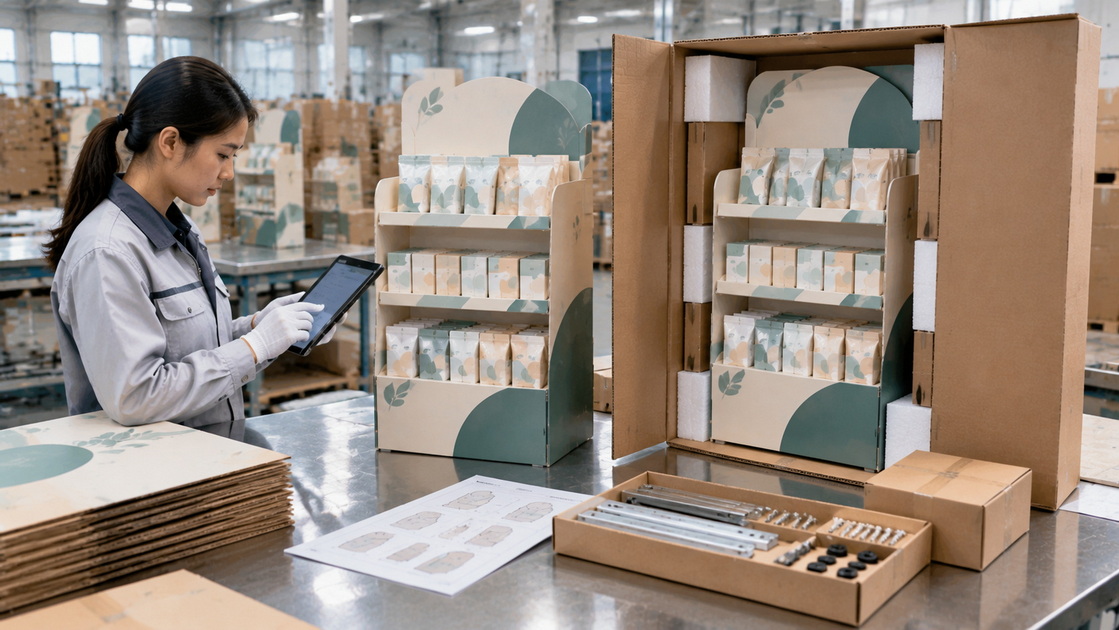
Mitchel Lincoln was established in Montreal in 1965. Its history records a partnership with Atlantic Packaging in 1968 and the acquisition of Imacor, a POP display design and manufacturing business, in 2016.
Atlantic's corporate information identifies Quebec, Eastern Canada, and national customers as important parts of Mitchel Lincoln's market coverage.
Mitchel Lincoln provides the clearest explicit corrugated-sidekick evidence among the Canadian packaging companies reviewed.
Its display portfolio includes a SidekickTower category, alongside counter displays, floor displays, dump bins, and pallet formats. It also advertises creative design, 3D drawings, prepress, digital printing, and vertically integrated turnkey service.
Its published custom-design services support discussion of original customer-branded displays and adaptations of existing formats.
Confirm whether the proposed SidekickTower is hanging, freestanding, or convertible. The category name alone does not establish compatibility with a particular retailer's mounting system.
Atlantic's acquisition of full ownership means the two profiles represent related businesses.
If a procurement policy requires independent supply continuity, examine shared materials, facilities, production dependencies, and commercial ownership rather than counting two company names as diversification.
Atlantic Packaging Products is a Canadian packaging business with operations serving Canada and parts of the United States. Its retail packaging and display division operates in Scarborough, Ontario.
An exact establishment year was not verified in the reviewed sources and should be confirmed directly if required for supplier records.
Atlantic publishes POP display and merchandising services covering pallet displays, bulk bins, counter displays, standees, and shelf-ready packaging.
It also describes co-packing and prepacked programs intended to simplify retail setup.
These capabilities make it relevant to brands coordinating packaging, display manufacture, and fulfillment.
Discuss custom graphics, structural development, packing configurations, and delivery requirements.
A dedicated hanging-sidekick product was not established from the reviewed Atlantic pages. Ask for a recent comparable project and a fixture-specific proposal.
Keep the Canadian business distinct from similarly named Atlantic packaging companies.
For example, a certification page at atlanticpkg.com concerns a different business and U.S. locations. It should not be used as evidence for Atlantic Packaging Products' Canadian facility.
Great Little Box Company was established in 1982 and is based in Richmond, British Columbia.
Its documented capabilities include corrugated packaging, custom displays, printing, and related packaging products. Its market presence includes Western Canada and the Pacific Northwest.
Canadian Manufacturers & Exporters describes GLBC's services as extending from design and printing through manufacturing and fulfillment, with shipping and warehousing flexibility.
That broader packaging capability may suit brands seeking coordinated display and product-packaging development.
Request a project-specific proposal covering original structure, branded printing, packaging, and any inventory-management services required.
The reviewed evidence establishes custom displays, but not a dedicated sidekick production line. Require a comparable sample before assuming fit.
GLBC publishes FSC and SFI certification statements. Verify current legal-entity coverage, site scope, and the claim applicable to the quoted products rather than relying on a website badge.
Certified sourcing does not establish shelf strength or attachment compatibility.
Marketing Impact Ltd. is identified in a trade-publication case example as the creator of a Twinings sidekick display, with an address in Concord, Ontario.
A verified founding year and current geographic sales breakdown were not established from the reviewed material.
The published project combined peg hooks and gravity-feed tracks within a compact sidekick.
It demonstrates relevant merchandising-design experience and shows that sidekick requirements can extend beyond simple cardboard shelves.
For custom work, request current capabilities, production locations, materials, and subcontractor responsibilities.
The documented Twinings example used a styrene substructure and a co-polymer graphic wrap. It should not be presented as evidence of an equivalent all-cardboard design.
A past case study demonstrates historical relevance, not current capacity or certification.
Ask for recent comparable work, a current technical proposal, and the precise manufacturing scope.
Provide the actual fixture drawing or verified measurements.
Specify:
- Mounting location.
- Attachment interface.
- Available width and depth.
- Adjacent obstructions.
- Loaded display weight.
- Required installation method.
Sidekick clips and hooks connect the display to another structure. The host fixture's permitted loading matters as much as the cardboard unit.
Do not approve "premium corrugated board" as the entire specification.
Define the relevant material construction and require testing of the finished assembly.
ECT measures edgewise board compression resistance; it does not directly establish the safe hanging load of a sidekick or the strength of a hook connection. FEFCO lists separate methods for different board properties.
Paper moisture changes with relative humidity, which can affect strength.
Provide expected warehouse, transport, and store conditions. Avoid treating a short dry-room sample check as proof of performance throughout the campaign.
FSC chain of custody addresses material traceability. It does not replace load, stability, attachment, or product-access testing.
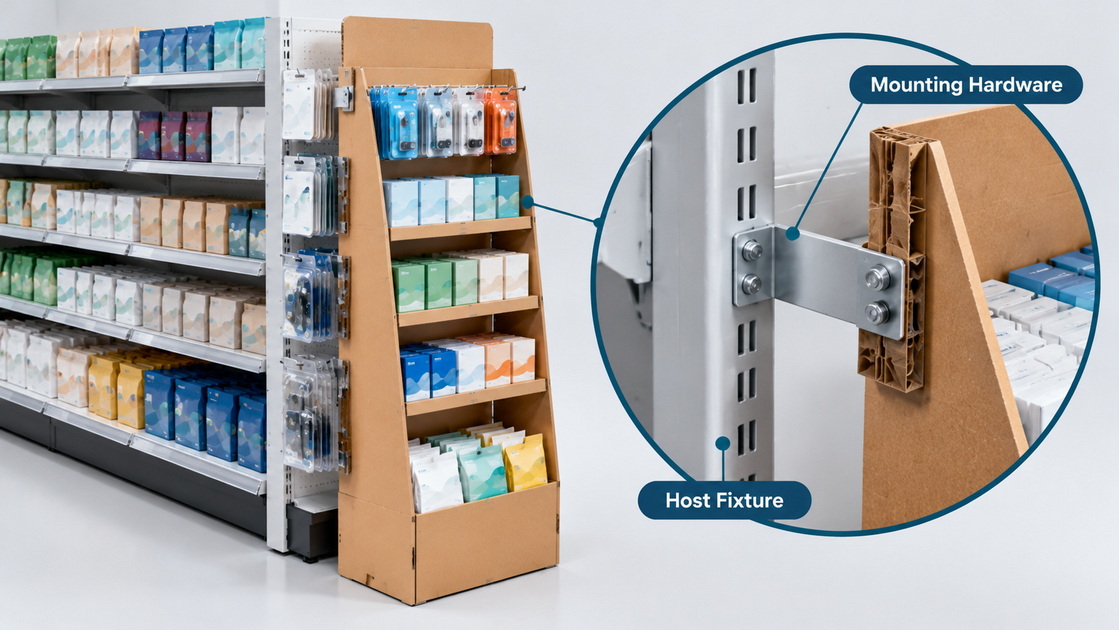
An attractive white sample can still fail at installation if the mounting clips, fixture geometry, or load path differ from the approved arrangement.
A freestanding inspection also cannot establish how a hanging display behaves.
Use a fixture-interface approval record:
1. Identify the host fixture.
2. Identify clips, hooks, or brackets.
3. Record the loaded configuration.
4. Check installation and removal.
5. Check product access and neighboring clearances.
6. Assess full and depleted stock conditions.
7. Prohibit unapproved hardware substitutions.
This is a proposed procurement control, not a universal engineering standard.
The practical lesson is to approve the installed system, not just the cardboard sample.
- White sample: Check fit, assembly, loading, and mounting.
- Color sample: Check graphics, product visibility, and production appearance.
- Production verification: Inspect units from the actual order against the approved specification.
Record material, drawing, artwork, hardware, and packing revisions together.
Ask which processes occur in-house and which are outsourced.
For an overseas supplier, include a production-site review appropriate to the order's risk. For a domestic supplier, do not assume proximity removes the need for qualification.
Include development, hardware, packing, preloading, inspection, transport, store labor, and replacement provisions.
Compare flat-packed and preloaded options against the same retailer requirements.
For imported displays, use a customs broker to review the actual material composition and shipment configuration rather than copying another project's tariff classification.
Long Win Display provides a China-based customization and preloading option. Mitchel Lincoln offers explicit SidekickTower development within an integrated Canadian packaging group. Atlantic brings retail packaging and co-packing capabilities, GLBC offers Western Canadian packaging support, and Marketing Impact has a documented specialist sidekick example.
Search the supplier's legal name or certificate details in FSC's public database. Check status, scope, and covered locations, then confirm the sales documents include the appropriate claim for the supplied products.
Do not assume so. Qualify the actual display, hardware, host fixture, and loading arrangement. A rating for one configuration should not automatically transfer to another.
No. ECT is one material property. Joints, mounting points, geometry, product distribution, and environmental conditions also require evaluation.
No. Preloading can reduce store work, but may increase transport volume and protection requirements. Compare the complete delivered and installed cost.
Include approved material and hardware details in the purchase specification. Require written change notification, retain a reference sample, and verify the actual production order before dispatch.
1. Canadian Corrugated and Containerboard Association — "Industry," 2026 industry overview and employment figures. [cccabox]
2. FEFCO — "Testing Methods & Recommendations." [fefco]
3. Mecmesin — "Edge Crush Test of Corrugated Cardboard." [mecmesin]
4. Billerud — Relative humidity and corrugated packaging performance guidance. [billerud]
5. Forest Stewardship Council — Public certificate search. [search.fsc]
6. Forest Stewardship Council — Chain-of-custody certification requirements and purpose. [fsc]
7. Long Win Display — "Our Company," including timeline, locations, services, markets, and advertised output. [longwindisplay]
8. Mitchel Lincoln — Company history and retail-display portfolio. [mitchellincoln]
9. Atlantic Packaging Products — Canadian operations, retail displays, and co-packing information. [atlantic]
10. Canadian Manufacturers & Exporters — Great Little Box Company profile. [cme-mec]
11. Great Little Box Company — Company history and environmental commitments. [linkedin]
12. Creative Magazine — Twinings sidekick project attributed to Marketing Impact Ltd. [creativemag]
13. Great Northern Instore — Power-wing and sidekick format descriptions. This U.S. company is used for format context, not presented as a Canadian manufacturer. [greatnortherninstore]


