
Views: 231 Author: Long Win Display Publish Time: 2026-09-28 Origin: Site


Content Menu
● What Changes With a High-SKU Assortment?
● Retail Shelving Displays vs Floor Displays
● Compare the Whole Operating Cost
● Three Decisions That Improve the Brief
>> 1. Map SKU Roles Before Drawing
>> 2. Test the Display Half Empty
>> 3. Give Shelves and Floor Units Different Jobs
● Safety, Access, and Retail Approval
>> 1. Are retail shelving displays always better for high-SKU categories?
>> 2. How many SKUs should a floor display hold?
>> 3. Can a pallet display replace the main category shelf?
>> 4. Should every SKU receive the same number of facings?
>> 5. What should a manufacturer receive before designing the display?
For high-SKU product categories, retail shelving displays usually provide the clearest way to help shoppers compare a full assortment, while floor displays give selected products greater visibility and promotional space. The strongest choice is often not one fixture or the other: it is a shelf plan that supports everyday selection, paired with a floor display designed for a specific launch, season, or fast-selling SKU group.
A display should do more than fit the products. It must help shoppers find the right variant, give store teams a practical way to replenish it, and perform in the location the retailer has approved. Those questions become harder as the assortment grows.

A SKU is a distinct sellable product variant. A skincare range might have different formulations, sizes, and scents; a hardware range might vary by application and specification. Even when the packages look similar, shoppers need to distinguish them quickly.
Adding SKUs creates a space trade-off. Give every variant a facing, and the best sellers may run out between replenishment visits. Give the best sellers more space, and less common variants may become difficult to find. Retail research treats assortment, shelf allocation, and replenishment as connected decisions, rather than separate design tasks.
This is why "How many SKUs can the stand hold?" is the wrong first question. Ask instead:
- Which variants must shoppers be able to compare?
- Which products need the most visible facings?
- How much stock must remain available until the next refill?
- What happens to the presentation when the fastest-selling SKU is depleted?
The answers determine whether the category needs a permanent browsing destination, a focused promotional display, or both.
Here, retail shelving displays means products merchandised within an established category shelf or compatible shelf fixture. Floor displays means freestanding POP units, including suitable pallet displays, placed in an approved sales-floor location. A floor display can contain shelves, but its placement and operational role are different from the main category shelf.
| Decision factor | Retail shelving displays | Floor displays |
|---|---|---|
| Shopper task | Compare variants within an established category | Notice a launch, offer, or selected product group |
| SKU breadth | Usually better suited to the fuller listed assortment | Usually stronger with a deliberately edited assortment |
| Brand presence | Shares visual space with adjacent products | Offers more dedicated graphic and structural space |
| Space control | Depends on the retailer’s shelf allocation and planogram | Depends on approval for a specific floor footprint and location |
| Replenishment | Fits the retailer’s established category routine | Needs a display-specific refill or sell-through plan |
| Best fit | Ongoing range navigation and repeat purchase | Seasonal activity, launches, and added inventory capacity |
| Main failure risk | Crowded facings and weak variant differentiation | A striking unit that hides SKUs, empties unevenly, or obstructs circulation |
These are design tendencies, not guaranteed sales outcomes. Location matters as much as format. In a study using scanner-panel data from a large U.S. grocery chain, shelf displays had the largest effect on brand choice among the display locations examined, while front endcaps had the largest effect on category purchase incidence. An endcap is not the same thing as every freestanding floor display, so the result should guide location testing—not be presented as a universal floor-display lift.
Shelving gives shoppers a familiar place to compare an ongoing range. A shopper looking for a particular size or formula can scan related products together, check prices, and return to the same category on a later visit.
It also gives the retailer a defined planogram: which SKU goes where, how many facings it receives, and how it will be refilled. That discipline is valuable for broad assortments. It does not, however, solve a poor allocation. More variants mean less space per item unless the category gains additional shelf area; insufficient capacity can increase refill work or leave stock unavailable to shoppers.
For shelf execution, prioritize recognition over decoration. Group variants by the attribute shoppers use first, then make the second-level difference legible through package fronts, shelf labels, or dividers. A beautiful color sequence is not helpful if it separates two products customers reasonably expect to compare.
A floor display can create a second encounter with the brand outside its normal shelf position. It can also carry larger graphics, present a launch story, or hold additional units of selected products. Multi-SKU floor and pallet displays may use shelves, trays, hooks, or compartments, but their structure should be planned around the assortment and store execution—not selected solely for visual impact.
The limitation is assortment clarity. A display with many nearly identical packs can turn a high-visibility opportunity into a search problem. Shoppers may see the brand from a distance yet struggle to find the exact variant at arm's length.
For that reason, a freestanding unit often works best as an edited destination: a coherent seasonal collection, a few related use cases, or a hero group supported by complementary variants. Keep the wider permanent range on the main shelf unless the floor footprint and replenishment plan genuinely support it.
The display purchase price is only one line in a retail program. Buyers and brand teams should compare the complete route from production to removal.
| Cost or effort | Questions to ask before approval |
|---|---|
| Fixture and graphics | Is this a short campaign or a replenishable program? What must withstand handling? |
| Packing | Will units ship flat, partly assembled, or prepacked with product? |
| Freight | How do loaded dimensions and weight affect the agreed shipping configuration? |
| Store setup | Who places the unit, and how many actions must they complete? |
| Replenishment | Who refills it, from which stock, and how often? |
| Display space | Has the retailer approved the exact footprint and location? |
| End of campaign | Who removes the unit or updates the graphics? |
A prepacked pallet display may simplify store setup and keep the intended SKU arrangement consistent. It also requires accurate pack-out, protection in transit, and a receiving process suited to its loaded size. Conversely, a flat-packed display may use a different shipping arrangement but shift assembly and loading work into stores. Multi-SKU launch guidance emphasizes testing the actual assortment, pack-out process, shipping configuration, and store setup together.
Do not assume that extra facings automatically justify a larger fixture. Research on retail space planning shows that more facings can affect demand, but the value of a plan also depends on available space, substitutions, and the cost of replenishment.
Start with a SKU matrix rather than a display sketch. For each item, record its package dimensions, loaded weight, planned quantity, likely demand, and reason for inclusion. Then identify its role:
- Core: The items customers routinely seek and that need dependable availability.
- Discovery: New or less familiar variants that benefit from explanation.
- Promotional: Items connected to the current campaign or offer.
- Supporting: Variants that complete the story but may not need equal space.
This classification is a planning tool, not a fixed industry formula. It helps prevent the common mistake of giving every SKU identical capacity simply because equal-looking compartments are easy to design. A sensible floor display might repeat core SKUs while giving discovery products fewer units but clearer labels.
A full display is the easiest version to photograph—and often the least revealing version to assess. In a full-scale prototype, remove the fastest-selling products first. Can shoppers still identify the remaining variants? Do packs tip forward? Does a retaining lip hide essential text once the front row is gone?
Test three states: full, partially depleted, and nearly empty. Have someone unfamiliar with the range locate a requested variant in each state. Then ask a store associate to refill it using the proposed stock and instructions. Full-scale and production-representative testing is recommended in multi-SKU display planning because drawings alone cannot establish product access, stability, or setup performance.
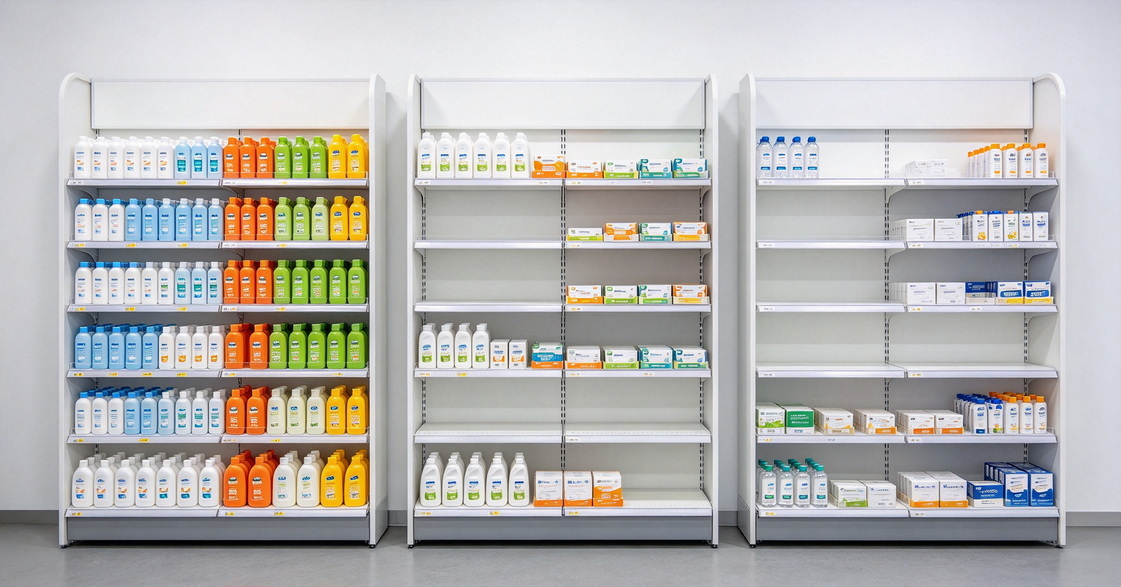
A hybrid plan should not simply duplicate the entire category. It should define what each location contributes.
Consider a hypothetical 24-SKU personal-care range. The main shelf carries the ongoing assortment, organized by product function and size. A nearby approved floor display carries six campaign-relevant SKUs with a short message explaining how to choose among them. The floor unit attracts attention; the shelf remains the place to browse the full range.
That example is an illustrative merchandising plan, not a measured case study. Its value lies in making a testable distinction: did the secondary display generate additional category interest without making the complete range harder to shop? Research finding different effects for shelf displays and front endcaps supports evaluating display locations by their specific objective rather than treating all extra display space as interchangeable.

No presentation benefit makes an unapproved or obstructive display a good choice. Before engineering a floor unit, obtain the retailer's location rules, permitted footprint and height, loading limits, and any requirements for graphics, packing, or installation.
For U.S. stores, keep accessible routes in the review. The U.S. Access Board explains that accessible routes generally need 36 inches of continuous clear width, with narrowly defined exceptions, and that protruding elements cannot reduce the required clearance. This is a route requirement—not a blanket claim that every retail aisle has the same required width in every circumstance. Confirm the store's actual layout and applicable requirements before placement.
Structural checks should cover the fully loaded display and realistic depletion patterns. Products concentrated high on a stand, an unevenly emptied shelf, or a protruding header can change the risk profile after installation. For a prepacked pallet unit, assess product retention and shipping protection as well as its in-store condition.

Use the following sequence before committing to production:
1. Set the objective. Is the priority full-range comparison, a launch, additional stock capacity, or a seasonal promotion?
2. Confirm the retail space. Ask which shelf allocation or floor location is actually approved.
3. Build the SKU matrix. Define variants, quantities, dimensions, facings, and refill frequency.
4. Prototype the shopping task. Test findability, removal, and replenishment when full and depleted.
5. Price the full program. Include packing, freight, store labor, and campaign removal—not only unit cost.
6. Run a controlled trial where possible. Compare similar stores and periods, recording both sales and execution quality.
Track availability and compliance alongside sales. Useful observations include whether the display was installed in the approved location, whether the correct SKUs arrived, which variants ran out first, and how long refill took. Otherwise, weak results may be blamed on the fixture when the real problem was missing stock or incomplete setup.
For measurement, define the outcome in advance: category sales, featured-SKU sales, margin, or incremental units. Compare test stores against an appropriate control group, and note price changes or other promotions that might affect the result. A display should earn its place through performance in the actual store—not a generic sales-lift claim.
For brands preparing a multi-SKU rollout, Long Win Display can use that brief to develop a custom POP solution, including a pallet display stand where the approved location and inventory needs make it appropriate. Share your SKU list, pack dimensions, target retailers, expected quantities, and proposed replenishment process to start a design and pre-assembly discussion.
No. Shelving is often the better home for a broad, ongoing assortment because customers can compare variants in the category location. A floor display may be more useful when the immediate goal is to spotlight a selected collection, promotion, or launch. The decision depends on the retailer's available space and the shopper's task.
There is no useful universal number. Capacity depends on package size, product weight, approved footprint, readable labels, stock depth, and refill frequency. Begin with the SKUs the display has a clear reason to feature; add more only if the prototype remains easy to shop when partially depleted.
It can serve as the primary presentation in some approved programs, but do not assume it should replace a permanent category location. Confirm whether shoppers will still expect to find the range in its normal aisle, and whether the pallet unit can support the required assortment, availability, and campaign duration.
Not necessarily. Equal facings may look orderly but can leave fast-selling variants short of capacity. Set facings and stock depth using expected demand, shopper importance, package size, and the refill schedule. Review the allocation after observing real sell-through.
Provide the SKU list, physical product samples or confirmed pack specifications, quantities per SKU, target retailer requirements, approved placement, campaign duration, graphics, shipping approach, and refill plan. State whether the unit must arrive flat-packed, partially assembled, or prepacked.
1. Han, Yoonju; Chandukala, Sandeep R.; and Li, Shibo. "[Impact of Different Types of In-Store Displays on Consumer Purchase Behavior]." “Journal of Retailing”, 98(3), 432–452. Research on how display locations relate differently to category purchase and brand choice. [ink.library.smu.edu]
2. Hübner, Alexander, and Kuhn, Heinrich. "[Decision Support for Managing Assortments, Shelf Space, and Replenishment in Retail]." “Flexible Services and Manufacturing Journal”, 36, 1–35, 2024. Research framework for evaluating assortment, facings, and replenishment together. [econstor]
3. U.S. Access Board. "[Chapter 4: Accessible Routes]." Official guidance used for the accessible-route discussion. [access-board]
4. PM Packaging. "[Retail Displays for High-Volume Multi-SKU Product Launches]." Industry guidance on assortment planning, pack-out, prototypes, and store execution; cited for production considerations, not independent sales results. [pmpackaging]


