
Views: 245 Author: Long Win Display Publish Time: 2026-10-24 Origin: Site


Content Menu
● What Is the Difference Between a Pop Up Gift Box and a Folding Gift Box?
● Pop Up Gift Box vs Folding Gift Box at a Glance
● Which Box Creates a Better Luxury Unboxing Experience?
>> Pop Up Boxes Make the Opening Action Part of the Story
>> Folding Boxes Can Deliver Luxury Through Restraint
>> Avoid Assuming That Complexity Improves Customer Response
● Materials and Finishing: What Actually Determines Quality?
>> Specify the Construction, Not "Premium Cardboard"
>> Match the Finish to the Folding Pattern
● Product Protection: Presentation Is Not a Shipping Test
>> Pop Up Gift Box Cost Drivers
>> Folding Gift Box Cost Drivers
>> Compare Cost per Accepted, Delivered Unit
● Freight, Assembly, and Retail Execution
>> Flat Packing Can Move Labor Elsewhere
>> Design Around the Retail Display
● Compare Complete Constructions
● How to Choose the Right Box: A Practical Development Process
>> Step 1: Define the Required Customer Moment
>> Step 2: Develop Comparable Prototypes
>> Step 3: Test Packing and Opening
>> Step 4: Approve a Production-Intent Sample
● How Long Win Display Can Support the Project
● FAQ
>> 1. Is a pop up gift box always a rigid box?
>> 2. Can a folding gift box look suitable for luxury products?
>> 3. Which format is better for heavy products?
>> 4. How can buyers prevent material substitution?
>> 5. Should the supplier test the empty box or the packed product?
Choosing a pop up gift box vs folding gift box for luxury unboxing comes down to one question: should the packaging create a dramatic reveal, or deliver an elegant experience with greater structural simplicity?
A pop up gift box can make the opening action part of the presentation. A folding gift box can achieve a refined appearance while simplifying storage, assembly, and production. Neither format is automatically more luxurious. The stronger choice depends on the product, customer expectations, fulfillment process, and total delivered cost.
From a packaging-development perspective, I would prioritize controlled presentation over decorative complexity. The box should open naturally, reveal the product clearly, and remain attractive after handling and transport.
For brands sourcing custom gift boxes, this guide compares both formats across design, materials, protection, manufacturing, sustainability, and retail execution.
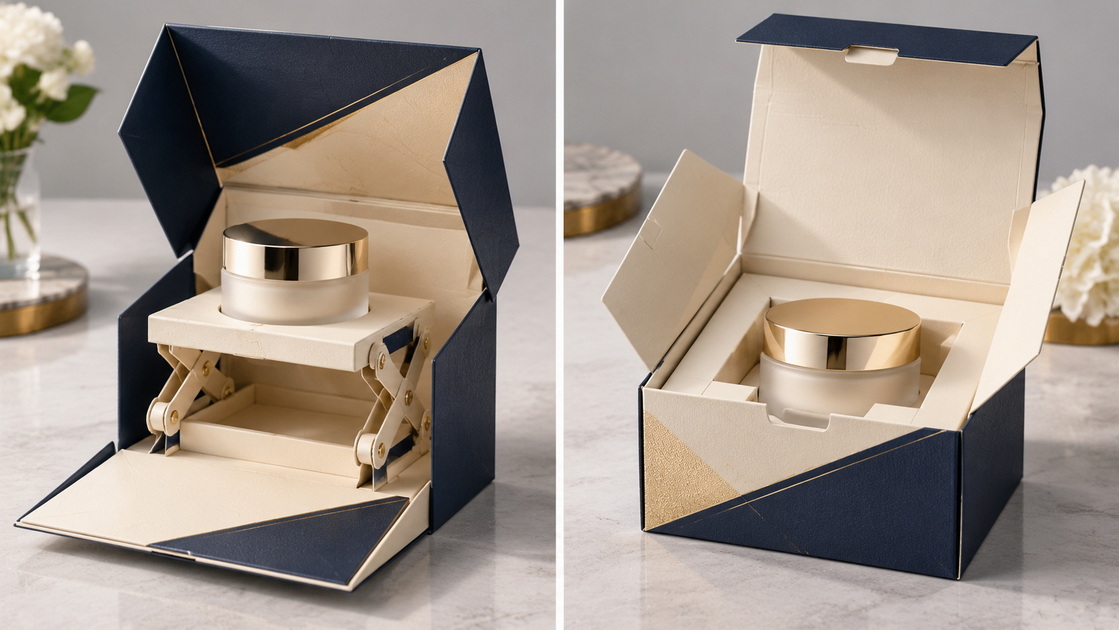
Packaging terminology is not standardized across every supplier. Some manufacturers use "pop up" to describe a collapsible rigid box that erects quickly. Others mean a presentation box with a moving internal reveal.
For this comparison, the terms have the following meanings.
A pop up gift box contains an engineered presentation feature that rises, unfolds, or changes position when the customer opens the package.
Examples include:
- A product platform lifted by the opening lid.
- A folding paper scene surrounding the product.
- Layered panels that reveal a gift progressively.
- An internal presentation element connected to the opening motion.
The outer box may be rigid or folding. "Pop up" describes the opening experience, not one specific board material.
A folding gift box uses scored panels, tabs, and sometimes pre-glued sections to form its structure.
This category includes lightweight folding cartons and certain collapsible presentation boxes. However, a folding carton and a collapsible rigid box are not identical: their board construction, assembly methods, and finished feel differ.
When requesting quotations, identify the exact structure rather than relying on either category name alone.
| Comparison factor | Pop up gift box | Folding gift box |
|---|---|---|
| Opening experience | Can create movement and a staged reveal | Usually offers a simpler, more direct opening |
| Structural development | Requires coordination of moving parts and clearances | Often uses established folding structures |
| Luxury expression | Theatrical, interactive, or storytelling-led | Restrained, tactile, or product-led |
| Product access | Must be checked against the reveal mechanism | Often more straightforward |
| Packing process | May require careful positioning around the mechanism | Can suit simpler packing workflows |
| Storage and freight | Depends on the complete construction | Flat shipment is often possible |
| Quality risks | Binding, misalignment, detached links, obstructed product | Fold cracking, poor closure, weak corners |
| Cost drivers | Development, assembly, components, inspection | Board, printing, finishing, inserts, quantity |
| Typical project fit | Launch kits, limited editions, presentation sets | Retail gifting, repeat programs, scalable assortments |
These are design tendencies, not guaranteed performance differences. A complicated folding box can cost more than a simple pop-up design, and either format can fail if poorly specified.
A pop-up mechanism is most useful when movement communicates something meaningful.
A fragrance discovery set might reveal several scents in sequence. A seasonal collection might unfold into a coordinated presentation. A corporate gift could expose a personalized message before presenting the product.
The mechanism should support the product rather than compete with it.
If customers need instructions to understand a simple gift, or if the moving panels hide the item, the design may be creating friction instead of value.
A folding gift box does not need a moving mechanism to feel considered.
Luxury can come from:
- Consistent panel alignment.
- Accurate color reproduction.
- A carefully selected paper texture.
- Balanced graphics and restrained finishing.
- A fitted insert.
- A smooth, intuitive opening sequence.
The practical question is not whether folding packaging looks expensive in isolation. It is whether its construction and finish suit the product's positioning.
A dramatic prototype may impress an internal team, but that does not establish higher conversion, stronger loyalty, or greater willingness to pay.
Where the decision matters commercially, test both structures with representative users. Observe opening, product removal, damage, and confusion—not only stated preference.
For either format, a useful specification identifies:
- Board type and thickness.
- Thickness tolerances.
- Wrapping or printing paper.
- Coating or lamination.
- Adhesives.
- Inserts and attachments.
- Finished dimensions and tolerances.
For a folding carton, crease performance and paper grain direction deserve attention. For a wrapped rigid structure, assess corners, wrap tension, hinge areas, and exposed edges.
A pop-up mechanism introduces additional interfaces. Its performance depends on the relationship between folds, attachments, platform weight, and opening geometry.
Foil, embossing, varnish, and lamination can enhance presentation, but their placement should be reviewed against folds, glue areas, and moving components.
Inspect a decorated production-intent sample. An unprinted prototype cannot demonstrate how the final printed and finished material will behave.
For high-contact areas, assess visible scuffing and handling marks. Define acceptable appearance with an approved sample rather than a vague requirement for "luxury quality."
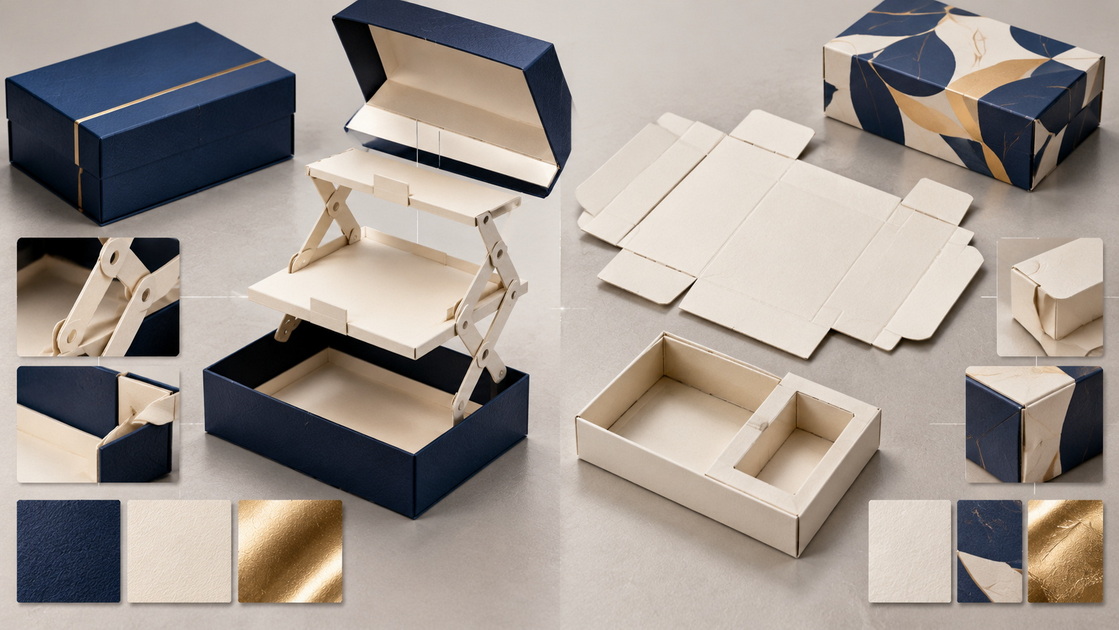
A gift box's opening experience and its transport performance are different engineering questions.
A pop-up platform may position the product beautifully without restraining it adequately during shipment. A folding box may hold its shape but require a better insert or shipping carton.
Evaluate the complete packed system:
1. The product.
2. Its insert or restraint.
3. The presentation box.
4. Any protective wrapping.
5. The outer shipping carton.
Distribution testing should reflect the actual route. A parcel shipment and a palletized retail delivery expose packaging to different conditions.
ISTA provides procedures for different distribution scenarios. The appropriate procedure should be selected for the packaged product and intended outcome rather than chosen simply because a supplier advertises "drop-tested packaging."
A pop-up design may add:
- Structural-development work.
- Additional die-cut components.
- More assembly operations.
- Tighter alignment requirements.
- Functional inspection.
- More complex packing instructions.
These costs depend on the mechanism. A simple paper linkage and an elaborate lifting platform should not be priced as equivalent products.
A folding box may reduce structural complexity, but its cost still depends on size, board, printing, finishes, inserts, and order configuration.
Different artwork across multiple SKUs can create separate setup costs even when the box dimensions remain unchanged.
A practical purchasing model includes:
> Box production + development + inserts + packing labor + freight + storage + inspection + expected defect and remake costs.
Request quotations on the same basis. Comparing an empty flat-packed box with a fully assembled and product-loaded presentation box produces a misleading result.
One useful qualification question is rarely addressed in attractive product photographs:
Will the box still open correctly after spending time closed, packed, and transported?
For a pop-up design, review whether moving elements bind, catch, or resist opening. For a folding box, assess whether panels remain aligned and closures operate as intended.
Do not evaluate only a freshly assembled studio sample.
A project-specific test plan can include:
- Opening after a representative storage period.
- Examination after relevant temperature and humidity exposure.
- Product removal with the intended load.
- Repeated operation where reuse is part of the design brief.
- Inspection for torn hinges, detached components, and permanent distortion.
Agree on conditions and acceptance limits with the supplier. There is no universal opening-cycle target suitable for every gift box.
Flat shipment may reduce empty-packaging volume, but it can transfer assembly work to the brand, fulfillment center, or retail store.
Before selecting a structure, establish:
- Who erects the boxes.
- What training is needed.
- How much work space is available.
- Whether inserts arrive fitted or separate.
- How assembly errors are detected.
- Whether the supplier will preload products.
A flat-packed box is not automatically the lowest-cost option once local labor is included.
For retail programs, packaging must also work within the display footprint.
Check shelf height, opening clearance, facing dimensions, replenishment, barcode visibility, and the condition of demonstration units.
A dramatic reveal box may work well as an open display sample while saleable units remain closed. A simpler folding box may be better for compact, frequently replenished assortments.
These are merchandising choices that should be resolved before finalizing the dieline.
Neither format is automatically the more sustainable choice.
A simple paper-based folding structure may avoid components found in a more elaborate design. However, conclusions still depend on material weight, coatings, inserts, damage rates, shipment configuration, and the destination's recovery systems.
For both options:
- Reduce unnecessary material.
- Avoid decorative components without a clear function.
- Assess whether inserts can be separated.
- Review local recyclability before making claims.
- Distinguish certified sourcing from recyclability.
FSC chain-of-custody certification concerns the traceability of forest-based materials. It does not independently establish that a finished gift box is recyclable or has a lower overall environmental impact.
Write a short brief describing what the customer should see first, how the product is removed, and whether the box is intended for reuse.
If a reveal mechanism has no clear purpose, start with the simpler structure.
Compare both options using the same product, presentation requirements, artwork direction, and distribution route.
Do not compare a highly finished pop-up sample with a plain folding mock-up.
Ask representative users to pack, open, and remove the product without coaching.
Record assembly mistakes, confusion, visible damage, and time taken. These observations can expose problems before tooling and production commitments increase.

Confirm the actual board, finishes, adhesives, insert, mechanism, and packing method.
Keep a revision-controlled approval record. Require written authorization before material or structural substitutions.
Long Win Display designs, customizes, manufactures, and pre-assembles gift packaging and POP displays, according to the company information provided for this article.
Its published company profile describes design, prototyping, printing, production, and delivery services. This makes integrated packaging-and-display development a relevant discussion for brands planning retail programs.
For a pop-up project, request evidence of the proposed mechanism rather than assuming that general gift-box experience establishes capability.
A useful development proposal should compare structural options, material choices, packing configurations, sample stages, and delivered costs.
Choose a pop up gift box when the reveal creates meaningful value and the mechanism can be manufactured, packed, and transported reliably.
Choose a folding gift box when refined presentation, simpler operation, and repeatable fulfillment better support the product.
No. "Pop up" can describe the reveal mechanism rather than the outer construction. Specify the board structure and movement separately.
Yes. Appropriate materials, accurate printing, clean construction, fitted inserts, and an intuitive opening can support luxury positioning without a moving mechanism.
Neither wins automatically. Assess the product weight, insert, load path, base construction, handling, and shipping system. A moving platform requires particular attention to its supported load.
Tie the approved sample to a written material specification and drawing revision. Require advance approval for changes to board, coating, adhesive, insert, and mechanism components.
Both may be useful during development, but transport protection must be assessed using the relevant packed configuration. Empty-box checks cannot establish protection of the product in distribution.
1. Long Win Display. Our Company. Company-provided background on design, prototyping, printing, production, packaging, and display services. [longwindisplay]
2. PackMojo. How to Order Custom Printed Boxes. August 3, 2026. Explains material categories, folding cartons, rigid boxes, and collapsible rigid structures. [packmojo]
3. PackMojo. Luxury Rigid Box vs Magnetic Closure Box. June 30, 2026. Describes non-collapsible and collapsible magnetic rigid-box construction. [packmojo]
4. QinPrinting. Paperboard vs. Corrugated vs. Rigid Boxes. April 23, 2026. Technical background on material construction and flat-shipping formats. [qinprinting]
5. International Safe Transit Association. Test Procedures. Official explanation of testing categories, intended outcomes, and procedure selection. [ista]
6. International Safe Transit Association. Getting Started with Design & Testing. Guidance on evaluating packaged-product protection during distribution. [ista]
7. UL Solutions. ISTA Packaging Test and Certification. Overview of vibration, impact, drop, and temperature testing used to assess transport performance. [ul]
8. Forest Stewardship Council. Chain of Custody Certification. Explanation of forest-based material traceability through production and distribution. [fsc]


