
Views: 253 Author: Long Win Display Publish Time: 2026-10-21 Origin: Site


Content Menu
● Paper Gift Box vs Magnetic Gift Box: Understanding the Structures
>> What Is a Magnetic Gift Box?
● Paper Gift Box vs Magnetic Gift Box Comparison
● Which Gift Box Creates a Stronger Premium Brand Impression?
>> Magnetic Gift Boxes Offer a Controlled Reveal
>> Paper Gift Boxes Can Communicate Quiet Luxury
>> Separate Board Weight From Board Thickness
>> Choose Finishes Around the Artwork
● The Closure Is Only One Component
>> Design the Insert Around the Product
>> Validate the Complete Shipping Pack
● Cost Comparison: Look Beyond the Quoted Box Price
>> Calculate Total Cost Per Delivered Unit
>> Illustrative Break-Even Example
● Flat Packed vs Preassembled Gift Boxes
>> Folding Paper Boxes Often Favor Space Efficiency
>> Magnetic Boxes Can Also Be Collapsible
>> Preassembly Should Be Evaluated Operationally
● Sustainability: Compare the Complete Material System
>> Paper-Based Does Not Mean Universally Recyclable
>> Simplify Materials Where Practical
● Closure Performance Changes With the Finished Product
● A Practical Gift Box Sampling and Approval Process
>> Step 1: Define the Commercial Brief
>> Step 2: Review Two Structural Options
>> Step 3: Approve a Production Specification
>> Step 4: Validate Production Consistency
● Which Gift Box Should Your Brand Choose?
● Develop Your Custom Gift Boxes With Long Win Display
>> 1. Is a magnetic gift box also a paper gift box?
>> 2. Are magnetic gift boxes always more expensive?
>> 3. Can a paper gift box look as premium as a magnetic box?
>> 4. Can magnetic gift boxes ship flat?
>> 5. Are either of these boxes waterproof?
Choosing a paper gift box vs magnetic gift box for premium branding is not simply a choice between affordable packaging and luxury presentation. Both formats can deliver a refined customer experience. The better option depends on your product, brand positioning, fulfilment process, and packaging budget.
There is also an important distinction: most magnetic gift boxes are themselves paper-based. They commonly use a rigid paperboard core, decorative wrapping paper, and concealed magnets.
For a useful comparison, this guide evaluates conventional non-magnetic paper gift boxes—including folding cartons and lift-off-lid rigid boxes—against magnetic-closure gift boxes.
My recommended starting point is brand fit: choose a structure that makes the product feel appropriately presented without creating unnecessary material, shipping, or assembly costs.

"Paper gift box" is a broad material-based description, not one standardized construction.
Common formats include:
- Folding paperboard boxes with tuck closures.
- Two-piece rigid boxes with separate lids.
- Drawer boxes with sliding trays.
- Foldable gift boxes with interlocking tabs.
Their performance varies considerably. A lightweight folding carton should not be treated as equivalent to a wrapped rigid box simply because both use paper-based materials.
For premium branding, a carefully proportioned lift-off-lid box can provide a presentation just as deliberate as a magnetic closure.
A magnetic gift box generally has a hinged lid or front flap held closed by concealed magnets, sometimes paired with metal plates.
It may be supplied as a fixed rigid structure or a collapsible design assembled before use.
The magnetic closure creates a controlled opening and closing action. However, it adds components and manufacturing steps, including magnet positioning, alignment, and retention.
| Purchasing factor | Non-magnetic paper gift box | Magnetic gift box |
|---|---|---|
| Available structures | Folding, lift-off lid, drawer, and other formats | Fixed or collapsible hinged structures |
| Brand presentation | Minimalist, decorative, or premium | Often suited to presentation-led packaging |
| Opening experience | Depends on lid, drawer, or tuck design | Hinged opening with magnetic retention |
| Cost drivers | Board, structure, printing, finishing, assembly | Same factors plus closure components and fitting |
| Shipping efficiency | Often favorable for folding formats | Depends on fixed versus collapsible construction |
| Packing workflow | Structure-dependent | Requires closure and assembly checks |
| Product protection | Depends on complete design and insert | Also depends on complete design and insert |
| Recycling considerations | Coatings, inserts, adhesives, and accessories | Same considerations plus embedded magnets |
| Typical decision priority | Structural simplicity and presentation flexibility | Controlled reveal and repeated closure |
Neither category automatically guarantees better quality. Compare finished specifications rather than product names.
A hinged magnetic lid keeps the opening movement connected to the box. This can support a staged presentation, particularly when products sit in a fitted insert.
Beauty sets, corporate gifts, and coordinated product collections may benefit from this arrangement.
However, the closure only contributes positively when the lid aligns cleanly, the wrapping is well finished, and the product remains securely positioned.
A poorly fitted magnetic lid can undermine an otherwise expensive design.
Premium presentation does not require a magnetic mechanism.
A rigid paper gift box with balanced proportions, a clean lift-off lid, restrained artwork, and a well-designed insert can communicate craftsmanship without additional hardware.
For brands emphasizing simplicity, the absence of a decorative closure may strengthen the intended message.
My design-review question would be: does the mechanism improve the product experience, or merely make the packaging more complicated?
Paper grammage, commonly expressed in grams per square meter, describes mass per area. Thickness describes physical depth.
These are different measurements, and neither alone establishes finished-box strength.
A procurement specification should identify:
- Structural board type and thickness.
- Wrapping paper or folding-carton stock.
- Surface treatment.
- Insert construction.
- Adhesive requirements.
- Finished internal dimensions and tolerances.
Avoid descriptions such as "premium thick cardboard" without measurable details.
Foil stamping, embossing, debossing, spot coatings, and printed textures can be used on different paper-based gift box formats.
The finish should support the design rather than compete with it.
For example, a small foil logo may provide enough visual emphasis without covering the box in decorative effects. Large dark surfaces may also make scuffing more noticeable, so handling tests should reflect the actual artwork.
Approve physical samples where color, texture, or finish is commercially important.
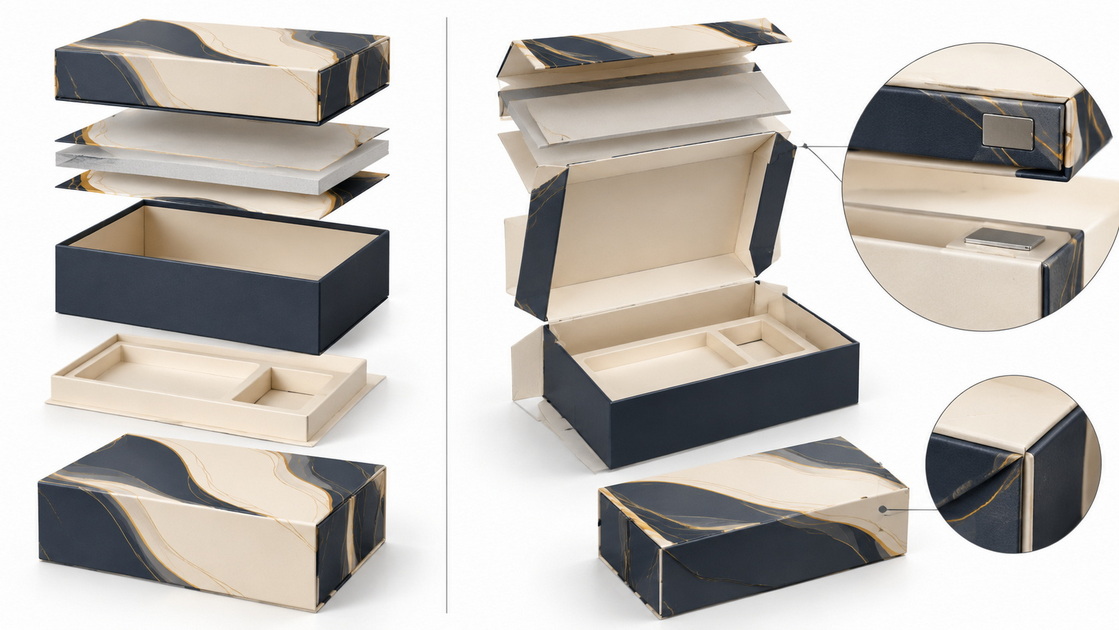
A magnetic closure holds a lid in place; it is not a substitute for protective engineering.
Protection depends on the combined performance of the outer structure, insert, product fit, and shipping packaging.
An insert should prevent unwanted movement without making removal frustrating.
Potential options include folded paperboard, corrugated structures, molded fiber, and other materials selected for the application.
Check:
- Whether the product contacts vulnerable surfaces.
- Whether accessories can move independently.
- Whether customers can remove the item comfortably.
- Whether the insert remains secure after transport.
- Whether different product sizes require separate versions.
A gift box with excessive empty space may look substantial while allowing damaging internal movement.
A retail presentation box is not automatically a shipping carton.
For direct-to-consumer orders, evaluate it together with the protective outer pack and any cushioning. For store delivery, assess the actual case configuration and handling route.
Do not infer transport performance from a pristine showroom sample.
For otherwise comparable constructions, magnets and their installation can add cost. But a highly decorated non-magnetic rigid box can still cost more than a simpler magnetic alternative.
The meaningful comparison is between approved specifications.
Include:
- Box and insert.
- Artwork preparation and tooling.
- Assembly or preassembly.
- Protective packing.
- Freight and storage.
- Packing labor.
- Damage and rework allowances.
Long Win Display's design, customization, production, and preassembly services can be discussed within this complete workflow. Confirm the exact scope in the quotation rather than assuming every service is included.
Assume a magnetic configuration costs $0.60 more per unit after relevant delivered-cost differences.
For an order of 5,000 units, the additional cost is $3,000.
If the contribution from each genuinely additional product sale is $15, the upgraded packaging would need to generate 200 additional sales to recover that cost.
This is an illustrative calculation, not a customer result or a claim that magnetic packaging increases sales. Other benefits, such as presentation consistency, should also be assessed—but not automatically converted into revenue.
Folding cartons generally ship flat and are erected during packing. This can reduce storage volume compared with similarly sized fixed rigid structures.
However, the benefit depends on packing speed, closure method, and the dimensions of the complete shipment.
A magnetic gift box does not necessarily arrive fully assembled.
Collapsible designs may reduce shipping volume, but introduce assembly steps involving folding panels, corner construction, or adhesive strips.
Request both an assembly demonstration and packed-carton dimensions. A box that is compact in transit may still create avoidable labor at the destination.
Preassembly can simplify the customer's packing process, while increasing the space required for shipping and storage.
Compare total workflow costs instead of assuming that flat packed or preassembled is always preferable.
Recycling performance depends on the construction and the receiving collection and processing system.
Coatings, adhesives, films, decorative elements, inserts, and other non-fiber components can affect recovery.
Likewise, a magnetic gift box should not be described as environmentally preferable simply because customers might reuse it.
Potential reuse is a design opportunity—not evidence of actual reuse or a lower overall environmental impact.
Consider whether the design can:
- Use a paper-based insert.
- Avoid unnecessary mixed-material accessories.
- Reduce oversized void space.
- Make components easier to separate.
- Provide disposal instructions appropriate to the destination market.
Do not assume that all foil decoration prevents recycling, or that every coating has the same effect. Industry guidance distinguishes between materials and the capabilities of individual recycling systems.
For magnets, confirm whether separation is necessary and practical under the intended disposal route.
An empty sample may close perfectly while a filled production box performs differently.
A tight insert, tall product, distorted panel, or accumulated assembly variation can prevent the flap from sitting correctly.
Rather than approving the closure in isolation, test it with:
1. The actual product and accessories.
2. The intended insert.
3. Production-representative board and wrapping.
4. Repeated opening and closing.
5. Relevant handling and transport conditions.
For magnetic designs, also check magnet retention and polarity. A loose magnet is a defect requiring corrective action, not merely an appearance issue.

Provide product dimensions, weight, intended audience, order quantity, sales channel, and target launch date.
Explain whether the box is mainly for retail shelves, online orders, corporate gifting, or a combination.
Ask for a non-magnetic and a magnetic proposal using comparable internal dimensions and presentation requirements.
This reveals whether the closure creates meaningful value for the application.
Record board construction, artwork revision, insert details, dimensions, finish, and assembly method.
For magnetic boxes, include closure layout and agreed functional checks.
Keep an approved reference sample and define inspection criteria.
Check dimensions, print appearance, corner wrapping, adhesive marks, insert fit, and closure behavior. Require approval before substituting materials or changing the construction.
Choose a non-magnetic paper gift box when structural simplicity, flat-pack efficiency, or a clean lift-off presentation is the priority.
Choose a magnetic gift box when the hinged reveal and repeated closure meaningfully support the product experience—and the additional cost and components are justified.
For many brands, the strongest option is not the most elaborate box. It is the one that consistently presents and protects the product while fitting the distribution model.
Long Win Display supports custom gift box design, production, and preassembly alongside its wider paper-based retail packaging and display work.
Usually, yes. Many magnetic boxes use rigid paperboard wrapped in paper. "Magnetic" describes the closure, while "paper" describes the main material.
No. Cost depends on size, construction, quantity, printing, inserts, and finishing. Magnets add components, but other design choices can outweigh that difference.
Yes. Proportions, material quality, finishing, product fit, and assembly quality can create a premium presentation without magnetic hardware.
Some can. Collapsible magnetic boxes are designed for assembly before use. Confirm packed dimensions, assembly steps, and the finished structure's performance.
Not by default. Water resistance depends on materials and treatments. Do not claim waterproof performance without appropriate evidence for the finished construction.
1. Hammont. "Rigid Boxes vs Folding Cartons: Premium Packaging Guide." October 16, 2026. Explains folding and rigid structures, magnetic formats, collapsible options, and differences in shipping and assembly. [hammont]
2. Hot Custom Boxes. "Magnetic Boxes vs Two Piece Rigid Boxes: Which Should You Choose?" August 21, 2026. Supplier-authored explanation of closure mechanisms, product reveal, construction, and fulfilment considerations. [hotcustomboxes]
3. RichPack. "The Ultimate Guide to Designing Magnetic Gift Boxes." May 11, 2026. Describes rigid and foldable magnetic structures, material components, and end-of-life considerations. [richpkg]
4. American Forest & Paper Association. "Design Guidance for Recyclability." Industry guidance on how coatings, adhesives, and other non-fiber components affect paper-based packaging recycling. [afandpa]
5. American Forest & Paper Association. "Design Guidance for Recyclability of Paper-Based Packaging." Technical document covering materials and recycling challenges. [afandpa]
6. PostPress. "American Forest & Paper Association Design Guidance for Recyclability: A Resource for Paper-Based Packaging Designers." March 15, 2023. Explains why recycling suitability depends on non-fiber elements and processing capabilities, including distinctions concerning decorative foils. [postpressmag]
7. Long Win Display. Company website and company background supplied for this article. Supports the stated gift box, packaging, customization, production, and preassembly scope; no customer performance results are claimed. [longwindisplay]


